
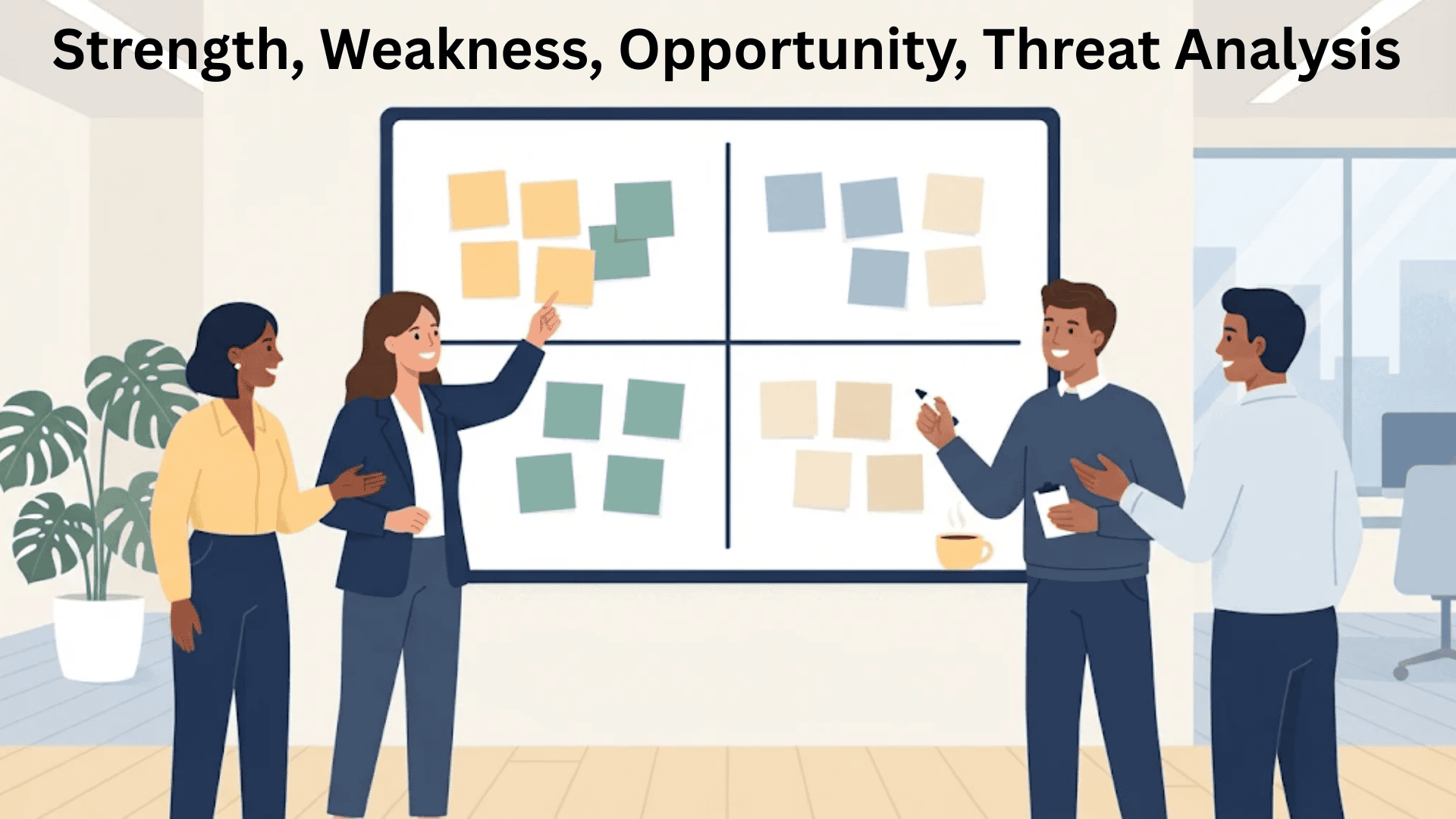
SWOT analysis is a planning tool that helps a business look honestly at itself and its environment. SWOT stands for strengths, weaknesses, opportunities, and threats. Strengths and weaknesses are internal factors you largely control, such as your team, brand, and cash position. Opportunities and threats are external factors you do not control, such as market trends, competitors, and regulations.
For small business owners, a SWOT analysis is one of the quickest ways to organize your thinking before a big decision, such as launching a product, entering a new market, or applying for funding. This guide covers the meaning, a copy-ready template, a worked hypothetical example, how to turn the results into action, and the limits you should know about.
Table of Contents
- SWOT Analysis: The Basics
- Where SWOT Analysis Came From
- The Four Parts Explained
- Strengths
- Weaknesses
- Opportunities
- Threats
- How to Do a SWOT Analysis Step by Step
- Free SWOT Analysis Template
- A Hypothetical SWOT Example: A Neighborhood Bakery
- Turning the Analysis Into Actions
- Advantages of SWOT Analysis
- Limitations of SWOT Analysis
- Common Mistakes and How to Avoid Them
- SWOT vs Other Planning Tools
- Frequently Asked Questions
- What does SWOT stand for?
- Who invented SWOT analysis?
- What is the difference between internal and external factors?
- How often should a small business do a SWOT analysis?
- Can I do a SWOT analysis for myself?
- Is SWOT enough to build a strategy?
- Conclusion
SWOT Analysis: The Basics
| Helpful | Harmful | |
|---|---|---|
| Internal (inside your business) | Strengths: what you do well | Weaknesses: where you fall short |
| External (outside your business) | Opportunities: favorable trends or gaps you could use | Threats: outside forces that could hurt you |
A SWOT analysis does not give you a verdict or a strategy by itself. It is a structured starting point for discussion. Its value comes from the conversation and the decisions that follow.
Where SWOT Analysis Came From
SWOT is generally linked to Stanford Research Institute (SRI) planning research in the 1960s. Albert Humphrey, a management consultant, is the person most often credited with it, and an early version was reportedly called SOFT, standing for satisfactory, opportunity, fault, and threat. However, the history is contested. Some commentators say the claim that Humphrey created SWOT cannot be firmly supported, and academic researchers have studied how SOFT evolved into SWOT. In short, SWOT emerged from SRI-era planning work, but the exact origin story is less settled than many websites suggest.
Later, Heinz Weihrich proposed a 2×2 matrix format in 1982 that is still widely used today.
The Four Parts Explained
Strengths
Internal advantages that help you compete. Ask: What do customers praise us for? What resources or skills do we have that rivals lack?
Examples: a loyal customer base, a skilled team, strong supplier relationships, a good location, proprietary know-how, healthy cash flow.
Weaknesses
Internal limitations that put you at a disadvantage. Ask: Where do we lose customers or waste money? What would an honest competitor say about us?
Examples: reliance on one client, weak online presence, limited cash, high staff turnover, outdated equipment, owner dependency.
Opportunities
External conditions you could take advantage of. Ask: What is changing in our market? Which customer needs are not being met?
Examples: a growing local population, a competitor leaving the market, new technology that lowers costs, a new sales channel, a favorable partnership.
Threats
External factors that could harm the business. Ask: What could shrink demand or raise our costs? What are competitors planning?
Examples: new competitors, rising input costs, changing regulations, economic slowdowns, shifting customer habits.
How to Do a SWOT Analysis Step by Step
- Define the question. Decide what you are analyzing: the whole business, one product, a new location, or a specific decision. A focused question produces a more useful result than a generic one.
- Gather evidence first. Look at sales figures, customer feedback, competitor offers, industry reports, and financial statements so the lists rest on facts rather than guesses.
- Involve different people. Include staff from sales, operations, and customer service if you can. Commentators note that one or two dominant voices can distort a SWOT.
- List items under each quadrant. Be specific. “Good service” is vague. “Customers rate us 4.8 out of 5 for response time in our own survey” is more useful, if it is true.
- Prioritize. Pick the three to five items in each quadrant that matter most. A list of 30 items is hard to act on.
- Connect the quadrants. Ask how your strengths can capture opportunities, how to fix weaknesses that expose you to threats, and which threats you can defend against.
- Turn it into actions. Assign owners, deadlines, and measures. Revisit the analysis regularly, because conditions change.
Free SWOT Analysis Template
Copy this table into a document or spreadsheet and fill it in for your own business.
| Strengths (internal) | Weaknesses (internal) |
|---|---|
| 1. 2. 3. |
1. 2. 3. |
| Opportunities (external) | Threats (external) |
|---|---|
| 1. 2. 3. |
1. 2. 3. |
Then answer three questions: Which two actions would use our strengths to capture opportunities? Which weaknesses most urgently need fixing? Which threat should we prepare for first?
A Hypothetical SWOT Example: A Neighborhood Bakery
This example is entirely hypothetical and for illustration only. It does not describe a real business.
Imagine a small bakery that has operated for six years in a residential area and wants to decide whether to start selling online.
| Strengths | Weaknesses |
|---|---|
| Loyal regular customers Recipes customers say they cannot find elsewhere Low rent from a long-term lease |
Owner handles most baking and all ordering No website or online ordering Limited equipment capacity |
| Opportunities | Threats |
|---|---|
| Local offices ordering catering Customers asking about pre-orders Local food markets and events |
A supermarket opening an in-store bakery nearby Rising ingredient prices Difficulty hiring trained bakers |
Turning the Analysis Into Actions
A useful way to connect the quadrants is a TOWS matrix, which pairs internal and external factors to suggest strategies.
| Pairing | Question | Possible action for the bakery |
|---|---|---|
| Strengths + Opportunities | How can we use what we do well to win new business? | Offer pre-ordered signature items and office catering using the recipes customers already love |
| Weaknesses + Opportunities | What gap blocks us from an opportunity? | Set up simple online ordering to capture pre-order demand |
| Strengths + Threats | How can we defend ourselves? | Lean on loyalty and distinctive recipes against the supermarket’s generic products. |
| Weaknesses + Threats | What do we need to fix to avoid the worst outcomes? | Train a second baker so the business does not depend only on the owner |
Notice that the result is not “do everything.” It is a short list of choices the owner can test and measure.
Advantages of SWOT Analysis
- Simple and cheap. It requires no special software or training.
- Balanced view. It forces you to consider problems and risks, not only positives.
- Good for discussion. It gets a team to share views and surface assumptions.
- Flexible. You can apply it to a business, a product, a project, or even a personal career decision.
- Supports other plans. It can feed into a business plan, a marketing plan, or a funding application.
Limitations of SWOT Analysis
SWOT is popular, but it has real weaknesses. Knowing them helps you use it properly.
- It is a snapshot. Critics note that the analysis can be static, while markets keep changing.
- Personal bias. The factors you list reflect who is in the room. Overconfidence or pessimism can skew results.
- Vague or overlong lists. Hasty lists of generic items do little. A well-known 1997 critique by Terry Hill and Roy Westbrook argued that in many cases nobody used the outputs afterward.
- No built-in prioritization. SWOT does not weigh items by importance or tell you what to do.
- Single-strength fixation. A team may over-focus on one strength, such as low cost, and neglect weaknesses such as quality.
- Blurry categories. The same factor can look like a strength or a weakness, or an opportunity or a threat, depending on perspective.
Treat SWOT as one input, not the whole strategy.
Common Mistakes and How to Avoid Them
- Mixing internal and external factors. Ask whether you control the item. If you do, it is a strength or weakness. If not, it is an opportunity or threat.
- Being vague. Replace generic statements with specific, evidence-backed ones.
- Listing everything. Prioritize the few items that really move the business.
- Doing it alone. Ask for input from staff, advisors, or customers.
- Stopping at the list. If no action follows, the exercise was wasted.
- Never updating it. Review it at least once a year and after major changes.
SWOT vs Other Planning Tools
| Tool | What it adds | Best used for |
|---|---|---|
| SWOT | Quick overview of internal and external factors | Early planning and team discussion |
| TOWS matrix | Pairs factors to create strategic options | Turning a SWOT into actions |
| PESTLE | Detailed look at political, economic, social, technological, legal and environmental factors | Understanding the wider external environment |
| SOAR | Focuses on strengths, opportunities, aspirations and results | Positive, forward-looking planning |
| Competitor analysis | Detailed review of rivals | Sharpening the threats and opportunities sections |
SWOT also fits into larger planning routines. For a broader look at how companies connect plans across teams, see our introduction to integrated business planning. If you are an early-stage founder preparing to join a startup program, our guide to technology business incubators explains what these programs look for.
Frequently Asked Questions
What does SWOT stand for?
Strengths, weaknesses, opportunities, and threats.
Who invented SWOT analysis?
It is generally associated with Stanford Research Institute planning work in the 1960s, and Albert Humphrey is often credited. The history is disputed, so it is safest to say it emerged from SRI-era research.
What is the difference between internal and external factors?
Internal factors, strengths and weaknesses, are things inside your business that you can influence. External factors, opportunities and threats, come from the market or environment and are outside your direct control.
How often should a small business do a SWOT analysis?
Many businesses do it annually and before major decisions such as launching a product, expanding,g or seeking funding. Update it if conditions change significantly.
Can I do a SWOT analysis for myself?
Yes. A personal SWOT looks at your skills, gaps, career opportunities, es and risks. The same four-quadrant structure applies.
Is SWOT enough to build a strategy?
No. It organizes your thinking, but you still need evidence, priorities, plans,ans and measures. Pairing it with a TOWS matrix and other tools gives better results.
Conclusion
A SWOT analysis helps a small business see where it stands: what it does well, where it is exposed, what the market offers,fers and what could go wrong. Its strength is simplicity, and its weakness is that simple lists can be shallow or biased. Use evidence, involve other people, prioritize ruthlessly, and convert the results into specific actions.
Next step: block out 60 minutes this week, fill in the template above with at least one other person, and finish by choosing two actions with owners and deadlines.
This article is for general educational purposes and is not professional business, legal, or financial advice. All examples are hypothetical. For major decisions, consider advice from a qualified business advisor or accountant.