
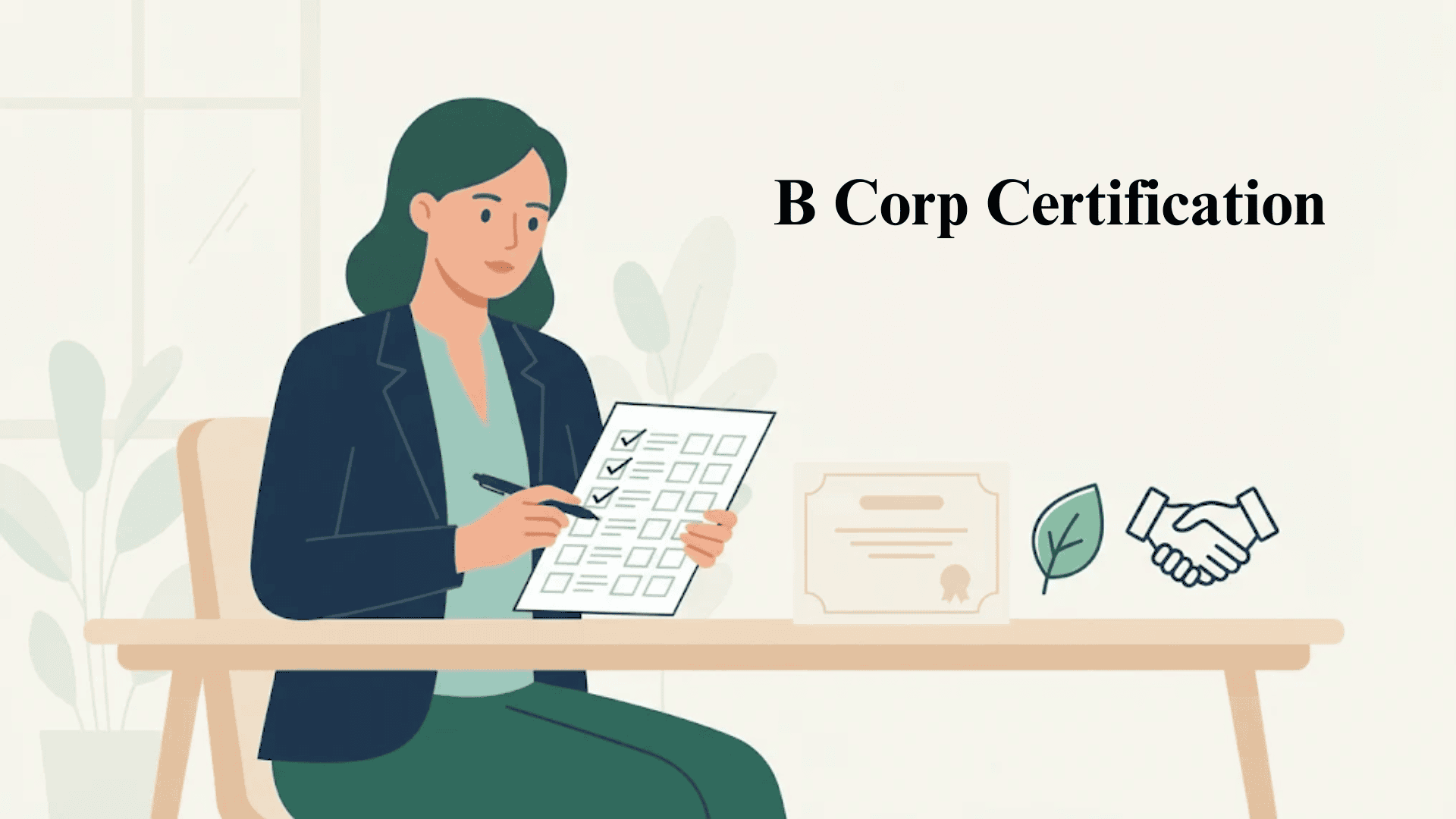
B Corp certification is a third-party credential that the nonprofit B Lab awards to for-profit companies that meet its standards for social and environmental performance, accountability, and transparency. It is not a legal structure and not a government license. A company that earns it can use the Certified B Corporation mark, and it must pay annual fees and keep meeting B Lab’s requirements.
The certification changed significantly in 2025 and 2026. B Lab replaced its long-running points system with a new set of standards, so much of the advice online, including the well-known “80 points” rule, is out of date for new applicants. This guide explains what B Corp certification involves today, what it costs, the application steps, the criticisms, and how to decide whether it is worth it for your business. Details are current as of November 2026, but B Lab updates its rules often, so confirm them on B Lab’s own site before you apply.
Table of Contents
- What Is B Corp Certification?
- What Changed in 2026
- B Corp Requirements Today
- Eligibility and Foundation Requirements
- The Seven Impact Topics
- How to Get B Corp Certification: Step by Step
- How Much Does B Corp Certification Cost?
- B Lab Fees in the US and Canada (2026)
- Other Countries
- Costs Beyond the Fee
- Benefits of B Corp Certification
- Drawbacks and Criticisms
- Is B Corp Certification Worth It?
- A Hypothetical Example
- Alternatives to B Corp Certification
- Frequently Asked Questions
- What is B Corp certification?
- How much does B Corp certification cost?
- How long does it take to become a B Corp?
- Is the 80-point score still required?
- Is a B Corp the same as a benefit corporation?
- How long does B Corp certification last?
- Can any company become a B Corp?
- Conclusion
What Is B Corp Certification?
B Lab is a nonprofit that was founded in 2006. It created and awards the B Corp certification for for-profit organizations. The certification signals that a company has been independently verified against standards covering how it treats workers, communities, and the environment, and how it governs itself.
Two points often confuse:
- It is a certification, not a company type. You do not become a “B Corp” by filing paperwork with a government. B Lab certifies you.
- It is not the same as a benefit corporation. A benefit corporation is a legal status in some US states and other jurisdictions. Certification is a private standard. A company can have one without the other, although B Lab requires certified companies to meet a legal stakeholder-governance requirement.
| Feature | Certified B Corp | Benefit corporation |
|---|---|---|
| What it is | A private third-party certification | A legal corporate status where available by law |
| Who grants it | B Lab | A government, through company law |
| Verification | Independent audit against B Lab standards | Legal duties; reporting rules vary by location |
| Ongoing cost | Annual fee based on revenue | Usually state or country filing fees |
| Availability | Eligible companies in many countries | Only where the law provides for it |
What Changed in 2026
B Lab published new standards, called Version 2, in April 2025, followed by updates in August 2025 (V2.1) and February 2026 (V2.2). The new standards apply to certification submissions from 2026. The main changes reported by B Lab and certification advisers include:
- No more points threshold. The old model required a verified score of 80 on the B Impact Assessment. Under the new standards, there is no minimum score. Instead, companies must meet specific requirements across seven impact topics.
- Third-party audits. Companies are verified by independent assurance providers.
- Phased requirements. Companies meet Year 0 requirements to certify, and further requirements by Year 3 and Year 5.
- Five-year certification cycle. Certification is no longer simply renewed on the old three-year basis, and additional audits and improvement requirements apply during the cycle.
- Existing B Corps must transition. Companies already certified must move to the new standards when they recertify.
If a website tells you that you need 80 points, it is describing the old system.
B Corp Requirements Today
Eligibility and Foundation Requirements
According to B Lab-based summaries, companies generally need to meet foundation requirements before they certify. These include:
- Eligibility. A for-profit business that has operated for at least 12 months.
- Legal commitment. Adopting B Lab’s stakeholder-governance legal requirement. This means formally giving the company’s governing documents or legal form a duty to consider all stakeholders, not only shareholders. The exact wording depends on your country or state.
- Risk assessment. A review of the company’s risk profile.
The Seven Impact Topics
You must meet minimum requirements in all seven topics.
- Purpose and stakeholder governance
- Climate action
- Fair work
- Justice, equity, diversity and inclusion (JEDI)
- Human rights
- Environmental stewardship and circularity
- Collective action
Requirements vary with the size and complexity of the company. Some advisers report that larger companies face stricter climate requirements, such as verified emissions footprints and science-based targets, while smaller companies face lighter versions. Check B Lab’s current requirements for your size band.
How to Get B Corp Certification: Step by Step
- Check eligibility. Confirm that you are a for-profit company with at least 12 months of operations and that you can meet the legal commitment.
- Complete the self-assessment. Register on B Lab’s platform and assess your company against the Foundation Requirements and the Year 0 requirements for your size. Advisers estimate this takes one to three months, depending on how organized your records are.
- Close the gaps. Update policies, collect evidence, set up measurements, and fix issues, such as pay practices or supplier standards. This is often the longest stage for small businesses that have never documented their practices.
- Submit for verification. A third-party assurance provider audits your evidence.
- Resolve findings. If the auditor identifies nonconformities, you fix them. B Lab says the time from submission to certification is roughly two to six months, depending largely on how many major nonconformities appear.
- Pay the fees and sign the agreement. Once the assurance provider recommends certification, B Lab invoices the annual fee, and you agree to the terms of use.
- Publish your profile and keep improving. Each B Corp has a public profile on B Lab’s site, and you must meet further requirements in later years.
How Much Does B Corp Certification Cost?
Costs have several parts: B Lab’s fees, the independent audit, the internal time you spend, and any improvements you need to make. Fees also differ by country, and B Lab says its fee structure is changing in 2026 and 2027.
B Lab Fees in the US and Canada (2026)
B Lab’s US and Canada page lists the following annual certification fees by revenue range for 2026. Note that the page is titled for existing B Corps, so new applicants should confirm what applies to them.
| Annual revenue | Certification fee (2026) |
|---|---|
| $0 to $5,000,000 | $2,100 |
| $5,000,001 to $7,500,000 | $3,150 |
| $7,500,001 to $10,000,000 | $3,938 |
| $10,000,001 to $15,000,000 | $6,300 |
| $15,000,001 to $20,000,000 | $8,925 |
| $20,000,001 to $30,000,000 | $12,600 |
| $30,000,001 to $50,000,000 | $16,800 |
| $50,000,001 to $75,000,000 | $21,000 |
| $75,000,001 to $100,000,000 | $26,775 |
Large companies and those with more than $1 billion in annual revenue have tailored pricing. B Lab also notes that part of the fee covers independent verification, that the fee structure is being updated in 2026 with further changes planned for 2027, and that in 2027 the annual fee will become an “Annual IP License and Community Fee.”
Other Countries
Fees and processes differ outside the US and Canada. For example, B Lab UK says its fees are frozen through 2026 and that it will absorb the cost of the initial audit for existing B Corps that must recertify on the new standards in 2026. Check the pricing page for your country.
Costs Beyond the Fee
- Audit costs for new applicants, depending on the country and company size.
- Staff time to gather evidence and respond to the auditor.
- Consultants or software, if you choose to hire help. These are optional.
- Improvement costs, such as raising wages, changing suppliers, measuring emissions,s or revising your legal documents.
- Legal fees for the stakeholder-governance amendment.
Benefits of B Corp Certification
- Independent credibility. A third party has examined your claims, which can matter more than self-reported sustainability statements.
- Structured improvement. The requirements give you a roadmap for governance, climate, workforce,ce and community practices.
- Community and network. Certified companies can connect with others and with buyers who value the label.
- Possible customer and talent appeal. Some customers, partners, ers and job seekers pay attention to credentials like this. How much it matters depends heavily on your industry and market, and there is no guaranteed sales or hiring effect.
- Protection of mission. The stakeholder-governance commitment can help keep your mission in place if ownership changes.
Drawbacks and Criticisms
- Cost and workload. Fees are ongoing, and small teams may find documentation and audits demanding.
- Complexity of the new standards. Advisers note that the 2026 standards require documentation many small businesses have never produced.
- No legal status. The certification is a private standard, not a government designation. Wikipedia’s summary of criticisms notes that B Lab’s standards are private and not accredited by an independent standards body.
- Fees tied to revenue. Critics have argued that revenue-based fees could create a perverse incentive for B Lab. This is an opinion about the model, not a finding of wrongdoing.
- Moving target. The standards and pricing have changed repeatedly, so planning can be harder.
- Certification does not mean perfection. It shows a company met specific requirements at a point in time, not that every aspect of its business is responsible.
Is B Corp Certification Worth It?
It depends on your goals, size, and market. These questions can help.
- Is impact already part of how you operate? The more you already meet, the lower the cost of certifying.
- Do your customers or partners ask for it? Some B2B buyers and retail partners value the label. If yours do not, the return may be smaller.
- Can you afford the full cost? Include fees, audit, staff time, and improvements, not just the headline fee.
- Are you willing to change governance documents? The legal commitment is not optional.
- Are you in it for the process or the badge? Companies that treat it as a roadmap tend to get more value than those that treat it as marketing.
A Hypothetical Example
This example is hypothetical and for illustration only.
Imagine a 25-person skincare company with $4 million in annual revenue. It already pays above local living-wage levels, sources some ingredients from certified suppliers,s and publishes a basic sustainability report. Its owners want to certify because several retail partners have asked about it. The company completes the self-assessment and finds gaps in climate measurement and supplier due diligence. It spends several months closing them, passes the audit, and pays an annual fee in the lowest revenue band. The owners consider the cost worthwhile because the process improved their operations and helped them win a retail listing. A similar company without retail partners asking for the label, and without existing practices to build on, might reasonably decide to wait or choose a lighter alternative. Results will differ for every business.
Alternatives to B Corp Certification
- Benefit corporation status, where your jurisdiction offers it, which embeds stakeholder duties in law.
- Industry-specific certifications, such as those for organic, fair trade,e or specific environmental standards.
- Publishing your own impact report, following a recognized reporting framework.
- Climate and supplier programs that focus on one area, such as emissions targets.
Check the credibility and cost of any alternative before you commit, and avoid making claims you cannot support. Regulators in several countries have tightened rules on misleading environmental claims, so make sure marketing statements are accurate.
Frequently Asked Questions
What is B Corp certification?
It is a third-party certification from B Lab that verifies a for-profit company’s social and environmental performance, accountability, ty and transparency against B Lab’s standards.
How much does B Corp certification cost?
It depends on your revenue and country. For 2026, B Lab’s US and Canada page lists annual fees starting at $2,100 for companies with up to $5 million in revenue. Audits, staff time, and improvements add to the total.
How long does it take to become a B Corp?
B Lab says the process from submission to certification takes about two to six months, depending mainly on how many major nonconformities the audit finds. Preparation before submission can add months.
Is the 80-point score still required?
No, not for submissions under the new standards from 2026. The old model required a verified score of 80 on the B Impact Assessment. The new standards use required actions across seven impact topics instead.
Is a B Corp the same as a benefit corporation?
No. A B Corp is a certification awarded by B Lab. A benefit corporation is a legal status available under some jurisdictions’ laws.
How long does B Corp certification last?
Under the current standards, certification runs on a five-year cycle with additional audits and improvement requirements during that period.
Can any company become a B Corp?
Not any company. It must be a for-profit business that meets B Lab’s eligibility rules, including having operated for at least 12 months, and it must be able to meet the legal and performance requirements.
Conclusion
B Corp certification can be a meaningful way to show that your company meets verified standards on governance, workers, communities, and the environment. Since 2026, it is also more demanding and more documented than the older points-based system. Whether it is worth it depends on how closely your existing practices match the standards, whether your market values the label, and whether you can afford the fees, audits, and improvements.
Next step: visit B Lab’s site for your country, check the current standards and fees for your company’s size, and complete the self-assessment as a free diagnostic before you decide whether to apply.
This article is for general educational purposes and is not legal, tax, or financial advice. B Lab’s standards, fees,s and processes change and vary by country, so verify current details directly with B Lab and consult a qualified adviser before changing your company’s governing documents.