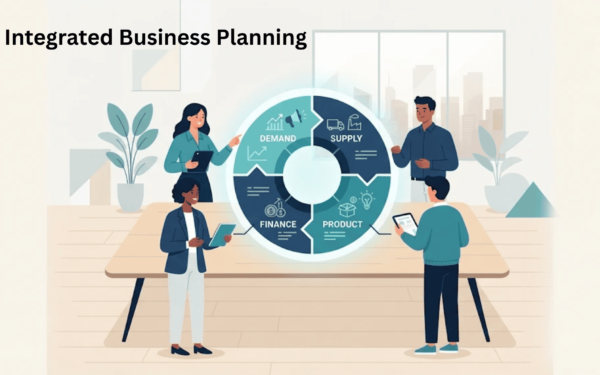

Integrated business planning (IBP) is a regular, cross-functional planning process that aligns a company’s demand forecasts, supply capacity, product plans, and financial targets with its strategy. Instead of sales, operations, marketing,g and finance each building separate plans, they work from one shared set of numbers and make decisions together, usually in a monthly cycle that looks 18 months or more ahead.
The idea is simple, but the details are often confused. IBP is frequently described as the next stage of sales and operations planning (S&O; there is no single universally agreed definition, and many vendor pages treat it as a software product. This guide explains what IBP is in plain English, how it compares with S&OP, the five-step monthly cycle, who is involved, the benefits and risks, and how smaller companies can adopt a lighter version.
Table of Contents
- Integrated Business Planning at a Glance
- Where Integrated Business Planning Came From
- IBP vs S&OP: What Is the Difference?
- The Five-Step Monthly IBP Cycle
- A Sample Monthly Calendar
- Who Takes Part in IBP?
- Benefits of Integrated Business Planning
- What Does the Evidence Say?
- Challenges and Why IBP Projects Fail
- How to Get Started With IBP
- Can Small Businesses Use IBP?
- A Hypothetical Example
- Key Metrics to Track
- Frequently Asked Questions
- What is integrated business planning in simple terms?
- What is the difference between IBP and S&OP?
- What are the steps in the IBP process?
- Who is responsible for integrated business planning?
- Do I need special software for IBP?
- How long does it take to implement IBP?
- Conclusion
Integrated Business Planning at a Glance
| Item | Summary |
|---|---|
| What it is | A monthly, cross-functional process to align demand, supply, product, and finance plans with company strategy. |
| Who leads it | Senior executives, with input from sales, marketing, operations, supply chain, product, and finance |
| Typical rhythm | Monthly cycle on a rolling horizon, often 18 to 36 months according to one consulting framework |
| Main output | One agreed plan with decisions, trade-offs and actions |
| Often used by | Manufacturers, distributors and consumer-goods companies, though the principles apply more widely |
| Related terms | S&OP, rolling forecasts, financial planning and analysis (FP&A) |
Where Integrated Business Planning Came From
IBP grew out of sales and operations planning, a process that balances customer demand with the resources needed to meet it. Several sources credit the consulting firm Oliver Wight with developing S&OP in the early 1980s and later using the term “integrated business planning” for its more advanced version, although other consultancies and software vendors have also promoted the term, and academic reviewers note that the literature is polarized around Oliver Wight’s viewpoint.
One SAS blog post argues that S&OP was originally meant to cover the whole domain now called IBP, but that this scope proved too broad to implement in the 1980s, so S&OP narrowed to supply and demand balancing. Whatever the exact history, IBP today usually means a version of S&OP that gives more weight to finance, product decisions, and strategy.
IBP vs S&OP: What Is the Difference?
The two overlap so much that some consultancies say there is very little difference and treat IBP as a more advanced S&OP. In practice, people usually draw the lines like this:
| Feature | Traditional S&OP | Integrated business planning |
|---|---|---|
| Main focus | Balancing demand and supply | Aligning demand, supply, product, finance, and strategy |
| Time horizon | Shorter-term tactical plan | Longer rolling horizon linked to strategy |
| Finance role | Limited, often a check at the end | Central: plans are reconciled to P&L, cash flow and budget |
| Product and portfolio | Often outside the process | Formal step in the cycle |
| Leadership | Often led by supply chain or operations | Executive-led across functions |
| Scenarios and risks | Sometimes | Usually built in |
A Deloitte Denmark page warns of a common confusion: IBP is not simply S&OP with a link to finance, nor an IT tool that holds several functions’ plans in a central place while those functions keep planning in parallel. The point is to change how decisions are made, not just where data is stored.
The Five-Step Monthly IBP Cycle
Step names and meeting formats vary by company and consultancy, but many descriptions follow a five-step monthly pattern based on Oliver Wight’s model. Here is a plain-English version.
- Product review. Marketing and product teams review the product portfolio: new launches, retirements, pricing, and priorities. This shapes what the demand and supply teams plan for.
- Demand review. Sales and marketing update the demand forecast, discuss assumptions, such as promotions and market changes, and agree on a consensus view of demand.
- Supply review. Operations and supply chain check whether capacity, materials, and logistics can meet the demand plan, and flag constraints or options.
- Integrated reconciliation (financial integration). Finance converts the plans into revenue, cost, profit,t and cash flow, compares them with the budget and targets, and highlights gaps. Unresolved issues and trade-offs are prepared for decision.
- Management business review. Executives review the integrated plan, make decisions on the open issues, approve the plan, and confirm actions and owners.
The cycle then repeats the following month with updated data. As one SAP-published interview with an IBP practitioner puts it, there is no “golden” IBP process because companies differ, but a five-step monthly process is widely seen as best practice.
A Sample Monthly Calendar
This calendar is illustrative. Real timing differs by company.
| Week | Activity |
|---|---|
| Week 1 | Update data and performance review; prepare product and portfolio inputs |
| Week 2 | Product review and demand review |
| Week 3 | Supply review; run scenarios and identify constraints |
| Week 3 to 4 | Financial integration; prepare options and recommendations |
| Week 4 | Management business review and decisions; communicate the plan |
Who Takes Part in IBP?
| Role | Contribution |
|---|---|
| CEO or general manager | Sponsors the process, chairs the management review, decides trade-offs |
| Sales and marketing leaders | Own the demand plan and market assumptions |
| Product or portfolio leaders | Own launches, retirements,nts and range decisions |
| Operations and supply chain leaders | Own capacity, inventory, sourcing and delivery plans |
| Finance leaders | Translate plans into financial outcomes and keep them aligned with the budget. |
| Planning or IBP lead | Runs the calendar, prepares data and facilitates meetings |
One university overview notes that IBP goes beyond involving senior management only at the decision stage: executives lead the process from start to finish, whereas S&OP has often been led by one or two stakeholders such as the supply chain head.
Benefits of Integrated Business Planning
- One set of numbers. Departments stop arguing over whose forecast is right and plan from a shared view.
- Better trade-offs. Decisions are weighed against profit and cash, not just departmental goals.
- Earlier warning. Capacity shortages, inventory risks, and financial gaps show up months ahead.
- Stronger link to strategy. Monthly decisions are tied to longer-term goals.
- Clearer accountability. Each plan has an owner, and each decision has a record.
What Does the Evidence Say?
McKinsey has reported that the average mature IBP practitioner realizes one or two additional percentage points in EBIT and service levels that are five to 20 percentage points higher than companies without a well-functioning IBP process. Treat this as indicative. It comes from one consulting firm’s research; it compares mature practitioners with others, and it does not prove that IBP caused the differences. Results vary widely with industry, execution, and starting point.
Challenges and Why IBP Projects Fail
- Lack of executive ownership. If leaders delegate the process, trade-off decisions stall.
- Silo habits. Moving from fragmented, function-based planning to one monthly cross-functional cycle is hard, and collaboration and commitment are essential, as the SAP interview notes.
- Poor data. If forecasts, inventory,y and cost data are unreliable, discussions turn into arguments about the numbers.
- Tool-first thinking. One consulting framework observes that tool-led projects without process and data discipline often stall.
- Too much complexity. Trying to plan every product and every scenario can overwhelm a team.
- Meetings without decisions. If the management review only reports information, the process loses value.
- Misaligned incentives. If sales bonuses, production targets, ts and finance goals conflict, people will optimize for their own function.
How to Get Started With IBP
- Get executive sponsorship. Agree who owns the process and who decides trade-offs.
- Define scope and horizon. Choose the product families, business units, or regions to include and the planning horizon.
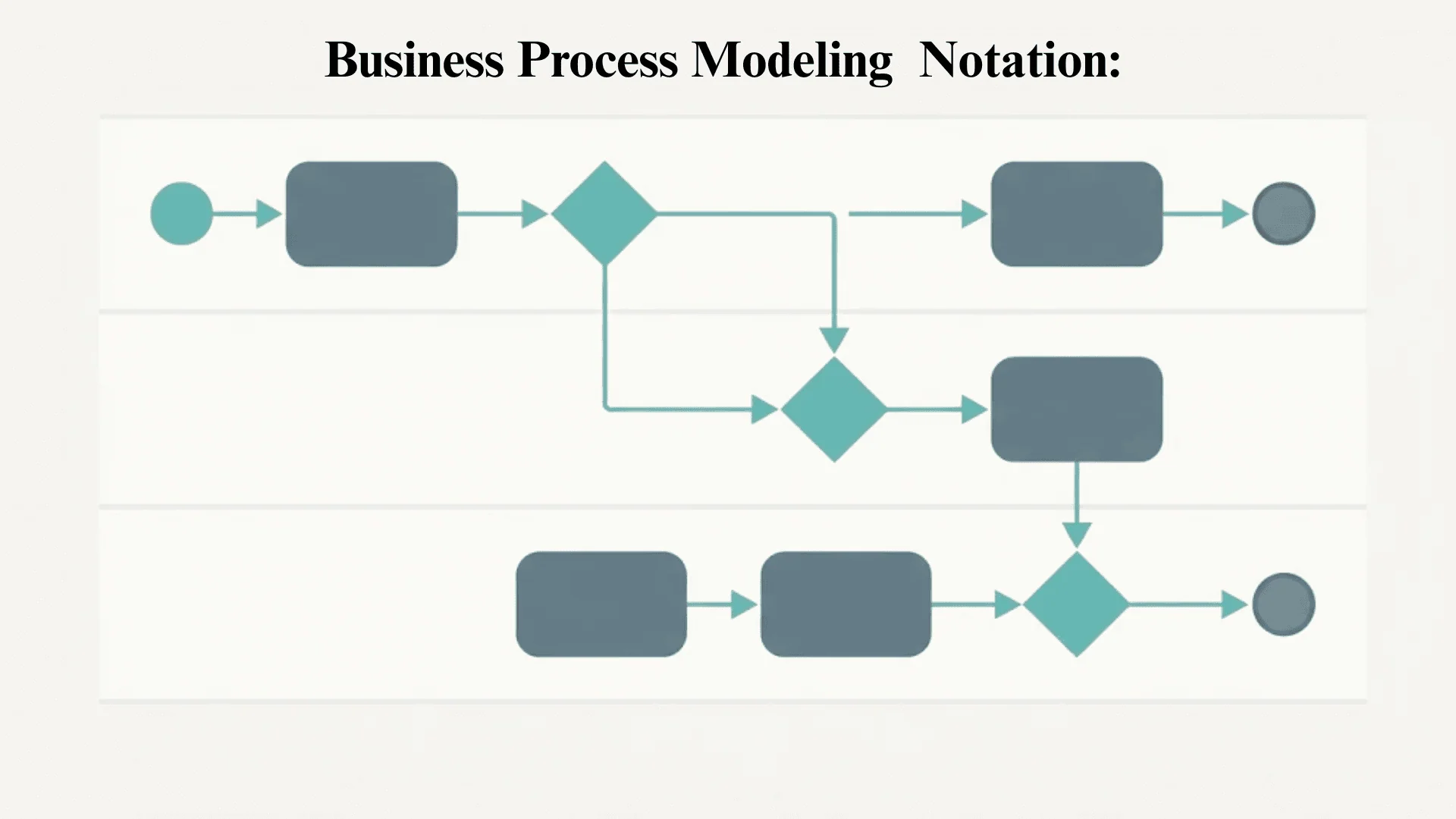
- Assess your current planning. Map who plans what, when, with which data, and where plans disagree. Process mapping using BPMN can help.
- Agree on a common data and assumptions set. Decide which forecast, cost and capacity numbers are the single source of truth.
- Design the monthly calendar. Set review meetings, inputs, outputs, and owners.
- Run a pilot. Start with one product family or business unit and refine the process.
- Measure and improve. Track forecast accuracy, service levels, inventory, plan adherence,e and decision speed. Expand once the process is stable.
- Select tools last. Spreadsheets can work for small scopes, and dedicated planning software can help at scale. Choose software to support a process you already understand. If you are evaluating software for the supply side, see our guide to supply chain management software.
Can Small Businesses Use IBP?
Formal IBP programs are typically designed for mid-size and large companies with several functions, product lines, and planning staff. A small business does not need all of that, but the underlying habit applies: one monthly meeting where sales operations and finance work from the same forecast and agree on decisions.
A lightweight version might include:
- One shared spreadsheet containing the sales forecast, inventory, capacity, and cash forecast.
- A60-0 t90-minutete monthly meeting of the owner, sales lead, operations lead, and whoever manages finance.
- A rolling 12-month view, updated each month, rather than a fixed annual budget that goes stale.
- A short list of decisions and owners recorded after each meeting.
This is an adaptation of IBP principles, not a certified methodology. It borrows the discipline without the heavy structure.
A Hypothetical Example
This example is hypothetical and for illustration only.
A small company sells specialty coffee equipment online and to cafes. Sales forecasts a big jump in demand for a new grinder after a trade show, operations says the supplier can only deliver half the volume in the first quarter, and finance points out that paying for a large inventory order would strain cash. Previously, each team made its own decision: sales promised delivery dates, operations ordered cautiously,y and finance delayed approval. In a monthly planning meeting, the owner puts all three views on one page. The team agrees to place a smaller first order, offer pre-orders to customers with realistic dates, and review demand again next month before committing to a second order. The company still faces limits, but the decision is made on shared facts, and every team knows the plan. The same cycle repeats the next month with updated data.
If you are reviewing large purchases like inventory or equipment as part of this process, our guides on capital spending and the SWOT analysis can help structure the discussion.
Key Metrics to Track
- Forecast accuracy and bias by product family.
- Service level, such as on-time and in-full deliveries.
- Inventory levels and turns.
- Plan adherence, which measures whether the company did what it agreed to do.
- Financial results against plan, including revenue, margin,n and cash flow.
- Decision speed, which measures how quickly open issues are resolved.
Set your own baselines and targets rather than copying industry figures, because definitions and conditions differ.
Frequently Asked Questions
What is integrated business planning in simple terms?
It is a regular process where a company’s sales, operations, product,uct and finance teams plan together using one set of numbers, make trade-offs, offs and agree on a single plan that supports strategy.
What is the difference between IBP and S&OP?
S&OP mainly balances demand and supply. IBP expands this by including finance, product decisions, longer horizons, and strategy, and by involving executives throughout. Many people treat IBP as the more advanced version of S&OP.
What are the steps in the IBP process?
A common five-step monthly pattern is product review, demand review, supply review, integrated reconciliation or financial integration, and a management business review. Names and details vary by organization.
Who is responsible for integrated business planning?
Executive leaders own it, and a planning or IBP lead typically facilitates. Sales, marketing, operations, supply chain, product,roduct and finance each own their part of the plan.
Do I need special software for IBP?
Not necessarily. Many small scopes start with spreadsheets. Software can help at scale, but process, data discipline,cipline and executive commitment matter more than the tool.
How long does it take to implement IBP?
It varies widely with company size, data, quality, and commitment. A pilot can run within a few months, but building a mature process usually takes much longer and requires continuous improvement.
Conclusion
Integrated business planning is a monthly habit of planning together. It links demand, supply, product and finance to a single plan so leaders can make better trade-offs and spot problems early. The framework is not new or magical, and the definition varies between consultancies and software vendors. Its value depends on executive ownership, trustworthy data, and decisions that actually get made.
Next step: schedule a 60-minute monthly meeting with your sales, operations, and finance leads, and bring a single shared forecast. Use it to agree on three decisions and owners, then repeat the following month.
This article is for general educational purposes only and is not financial, operational, or professional advice. IBP practices and terminology differ between organizations and consultancies, so adapt the process to your own business and consult qualified advisers for major planning or investment decisions.