

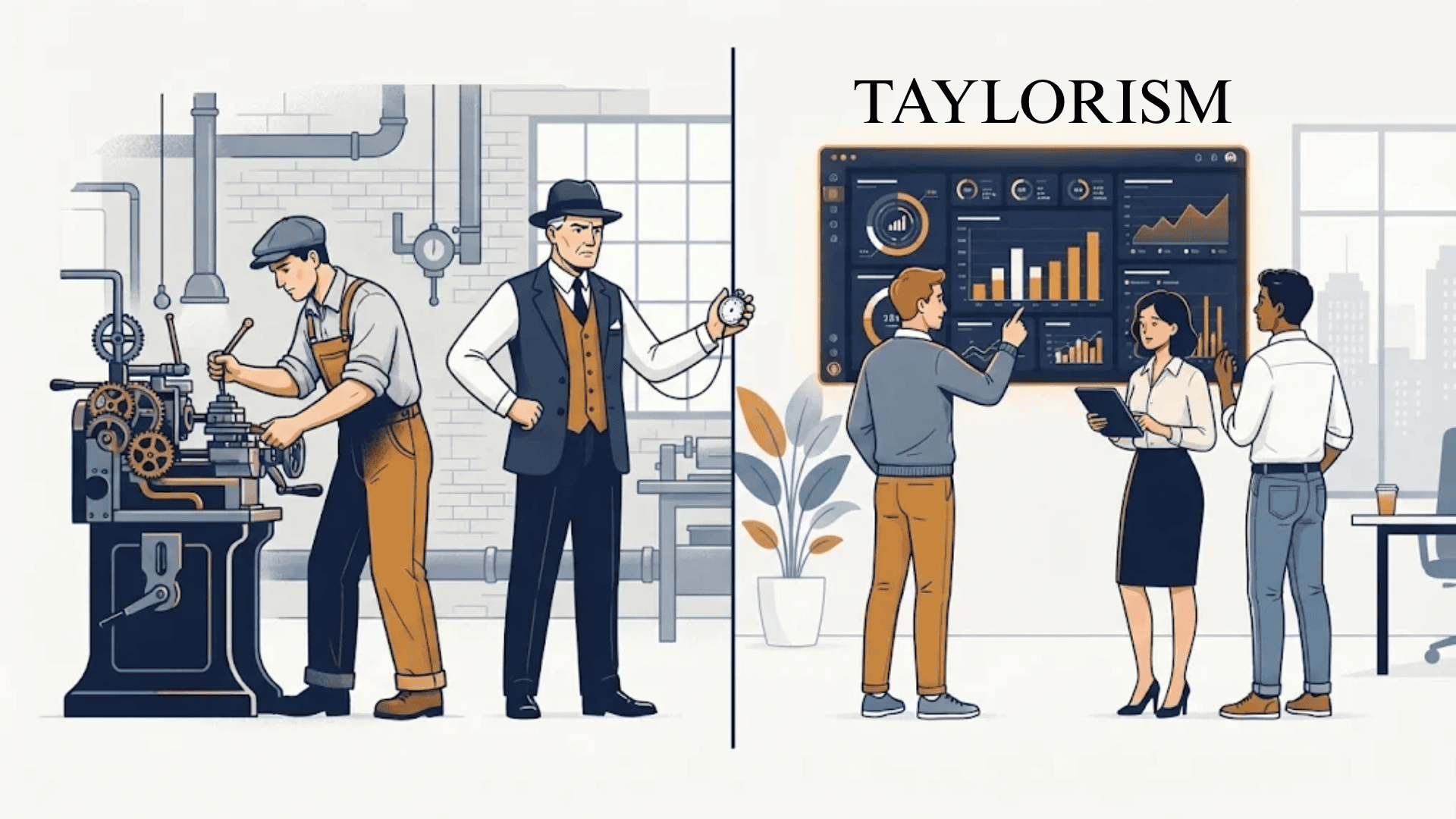
Taylorism, also called scientific management, is a management theory developed by American engineer Frederick Winslow Taylor in the late 19th and early 20th centuries. Its central idea is that work should be studied, measured, and standardized so that each task is done in the most efficient way, rather than left to habit or guesswork.
More than a century later, the idea still shapes how warehouses, call centers, factories,s and software teams are run. It also still draws criticism. This guide explains what Taylorism is, its four principles, what it got right, where it fails, and which lessons modern teams can use without repeating its mistakes.
Table of Contents
- Taylorism at a Glance
- Where Taylorism Came From
- The Four Principles of Scientific Management
- Time and Motion Studies Explained
- What Taylorism Got Right
- Criticisms of Taylorism
- Taylorism vs Modern Team Management
- Taylorism Today: From Factory Floors to Algorithms
- Lessons for Modern Teams
- What to Keep
- What to Avoid
- A Hypothetical Example
- Is Taylorism Still Relevant?
- Frequently Asked Questions
- What is Taylorism in simple terms?
- What are the four principles of Taylorism?
- Who invented Taylorism?
- What is the difference between Taylorism and Fordism?
- What are the main criticisms of Taylorism?
- Is Taylorism still used today?
- Conclusion
Taylorism at a Glance
| Item | Summary |
|---|---|
| Founder | Frederick Winslow Taylor (1856 to 1915), an American mechanical engineer |
| Key work | The Principles of Scientific Management (1911) |
| Core idea | Find the best method for each task through study, then train workers to follow .it |
| Main tools | Time studies, standard methods, task planning separated from task execution |
| Best known for | Raising industrial efficiency; also criticized for treating workers as machine parts. |
Where Taylorism Came From
Taylor began his career in American industry, and the Midvale Steel Company is often described as the birthplace of scientific management. He believed the management of his day was amateurish and that management could become a discipline based on observation and measurement.
His philosophy held that pushing people to work harder was less effective than improving the way the work itself was designed. In 1911, he published The Principles of Scientific Management. The term “scientific management” itself was popularized by lawyer Louis Brandeis during a rate case, and Taylor then adopted it for his book, according to the New World Encyclopedia.
Others extended the movement. Frank and Lillian Gilbreth developed motion studies, and Henry Gantt created the Gantt chart, a scheduling tool still used in project management today.
The Four Principles of Scientific Management
Taylor’s approach is usually summarized in four principles. Here they are in plain English, with a modern reading of each.
- Develop a science for each element of work. Replace rule-of-thumb methods with methods found through observation and measurement. Modern version: document a process, test it, and improve it with data.
- Select, train, and develop workers scientifically. Match people to tasks they can do well and train them in the best method. Modern version: structured hiring and onboarding.
- Cooperate with workers. Managers should make sure the work is actually done according to the developed method. Modern version: coaching and quality checks.
- Divide work and responsibility between managers and workers. Managers plan; workers execute. Modern version: this is the most controversial principle, because it separates thinking from doing.
Several educators also note that Taylor believed the system required what he called a “thought revolution in management.” In other words, he argued that applying the techniques without the underlying philosophy would fail.
Time and Motion Studies Explained
Taylorism is closely associated with time studies, where a task is timed and broken into steps to find the quickest method. Motion studies, developed by the Gilbreths, examine the physical movements within a task to remove waste.
The aim was to identify what Taylor called “one right way” to perform a task. That idea is exactly what modern critics challenge, because it assumes work has one best method that suits everyone.
What Taylorism Got Right
- Measurement over guesswork. Studying how work happens is still the basis of process improvement.
- Standard methods. Documented procedures reduce errors, speed up training,g and make quality repeatable.
- Task design matters. Taylor’s point that how work is organized affects output is widely accepted.
- Management as a discipline. He argued that management deserved systematic study, and that idea influenced business education.
- Lasting tools. Scheduling charts and task optimization remain common in industry.
Criticisms of Taylorism
- Deskilling. When planning is removed from the worker, jobs can become narrow and repetitive. A University of Alberta teaching summary describes Taylorism as a bureaucratization of control that offered little career development for most workers.
- Low motivation. Extreme specialization conflicts with modern ideas about meaningful, motivating work.
- Weak teamwork. Breaking jobs into small solo steps does not suit collaborative or creative work.
- Measurement as control. The strongest criticism is that measurement can become a tool of control rather than improvement.
- Ignoring social factors. The Hawthorne studies (conducted between 1924 and 1932) shifted attention toward attitudes, relationships, and supervision. Their interpretation has since been challenged, but they remain a standard counterpoint to Taylor’s focus on method alone.
Taylorism vs Modern Team Management
| Topic | Taylorism | Modern team approach |
|---|---|---|
| Who plans the work? | Managers | Shared between managers and teams |
| Method | One best way, set from above | Standards plus room for team input |
| Worker role | Execute defined tasks | Solve problems and suggest improvements |
| Motivation | Pay and clear targets | Pay, purpose, autonomy and development |
| Best suited to | Repetitive, predictable tasks | Variable, creative or complex work |
Taylorism Today: From Factory Floors to Algorithms
Pure Taylorism is rarely practiced as Taylor described it, but its logic appears in new forms. Researchers use the term neo-Taylorism or digital Taylorism to describe work that is tightly measured standardized, digitized, and monitored with software.
Examples discussed in the research literature include warehouses and call centers. A study of French and German retail warehouses found a convergence on digitally enhanced neo-Taylorism, characterized by deskilling and tighter performance control, though stronger worker rights produced somewhat less intense forms of it. In call centers, researchers have described the experience as an “assembly line in the head.”
The International Labour Organization has examined this link directly. Its researchers define algorithmic management as the use of software to automate managerial functions, and their multi-sector analysis argues that strong institutions, such as data protection rules and collective bargaining, can help rebalance power and prevent exploitative uses. Industry coverage of logistics and health care has similarly found that technology can increase efficiency while raising concerns about job quality and invasive monitoring.
The takeaway is not that measurement is bad. It is that the same tools can serve improvement or control, depending on how they are used.
Lessons for Modern Teams
What to Keep
- Map your processes. Write down how repeatable work is actually done. Process notation tools such as BPMN can help.
- Standardize the routine, not the thinking. Use checklists and templates for predictable tasks, and leave judgment calls to people.
- Use data to find bottlenecks. Look for where work waits, not who is slowest.
- Train properly. Good onboarding is a direct descendant of Taylor’s second principle.
What to Avoid
- One best way for everything. Ask the people doing the work what slows them down.
- Surveillance disguised as measurement. Track outcomes and process health, not every minute of a person’s day.
- Separating planning from doing in roles that need creativity or customer judgment.
- Targets without context. A number that ignores quality or safety can push people to cut corners.
The leadership trade-off here is similar to the one in our guide to task-oriented vs relationship-oriented leadership.
A Hypothetical Example
This example is hypothetical and for illustration only.
Imagine a small online store whose packing team frequently ships late. A manager shadows the team for a week and notices that packers keep walking to a far shelf for shipping labels and that returns and new orders are handled in the same queue. Taking a Taylorist step, the manager maps the process, moves the label closer,oser and separates the queues. That is a legitimate use of method study.
Now imagine the manager also adds a screen showing each packer’s orders per hour, ranked in real time. Speed may rise for a while, but error stress ,tr ess and turnover could rise too. A better approach is to share team-level targets, review error rates alongside speed, and ask the team for suggestions each month. The first step uses Taylor’s strengths. The second step shows his risks.
Is Taylorism Still Relevant?
Yes, in two ways. As a method, studying and standardizing routine work is still standard practice in operations, logistics,istics and manufacturing. As a warning, it shows what happens when efficiency becomes the only goal. The most effective modern teams tend to combine clear processes with real autonomy, though the right balance depends on the kind of work.
Frequently Asked Questions
What is Taylorism in simple terms?
Taylorism is a way of managing work by studying tasks, finding the most efficient me,tmethodd and training workers to follow it. It is another name for scientific management.
What are the four principles of Taylorism?
They are: develop a science for each element of work; scientifically select and train workers; cooperate with workers so the method is followed; and divide work and responsibility between managers and workers.
Who invented Taylorism?
Frederick Winslow Taylor, an American mechanical engineer, developed the approach and published The Principles of Scientific Management in 1911.
What is the difference between Taylorism and Fordism?
Taylorism is a method of organizing and measuring work. Fordism usually refers to Henry Ford’s mass-production system built around the moving assembly line. They are related ideas, but historians debate how directly one influenced the other.
What are the main criticisms of Taylorism?
Critics argue it deskills work, lowers motivation, weakens teamwork, ignores social factrs,, and can turn measurement into control.
Is Taylorism still used today?
Elements of it are common in operations, logistics, a nd customer service, and researchers describe digital forms as neo-Taylorism or algorithmic management. Few organizations apply it exactly as Taylor described.
Conclusion
Taylorism gave management a lasting habit: study the work before judging the worker. Its weakness is treating people as interchangeable parts. Modern teams do best when they borrow its discipline, such as clear processes, good training, and honest measurement, while keeping the autonomy and trust that Taylor’s system left out.
Next step: pick one repetitive process in your business, map it on a single page, and ask the people who do it what slows them down before you change anything.
This article is for general educational purposes only. Workplace monitoring and employment rules vary by country and state, so check local requirements or consult an employment professional before introducing performance tracking.