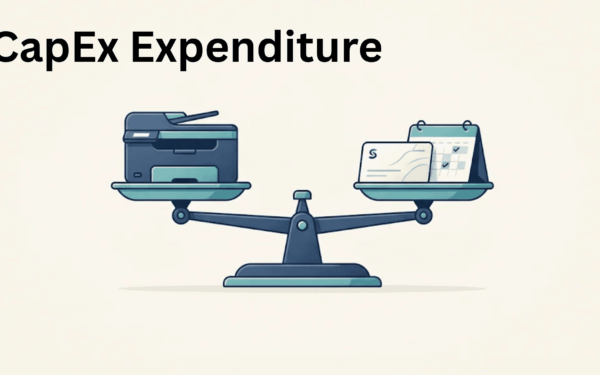

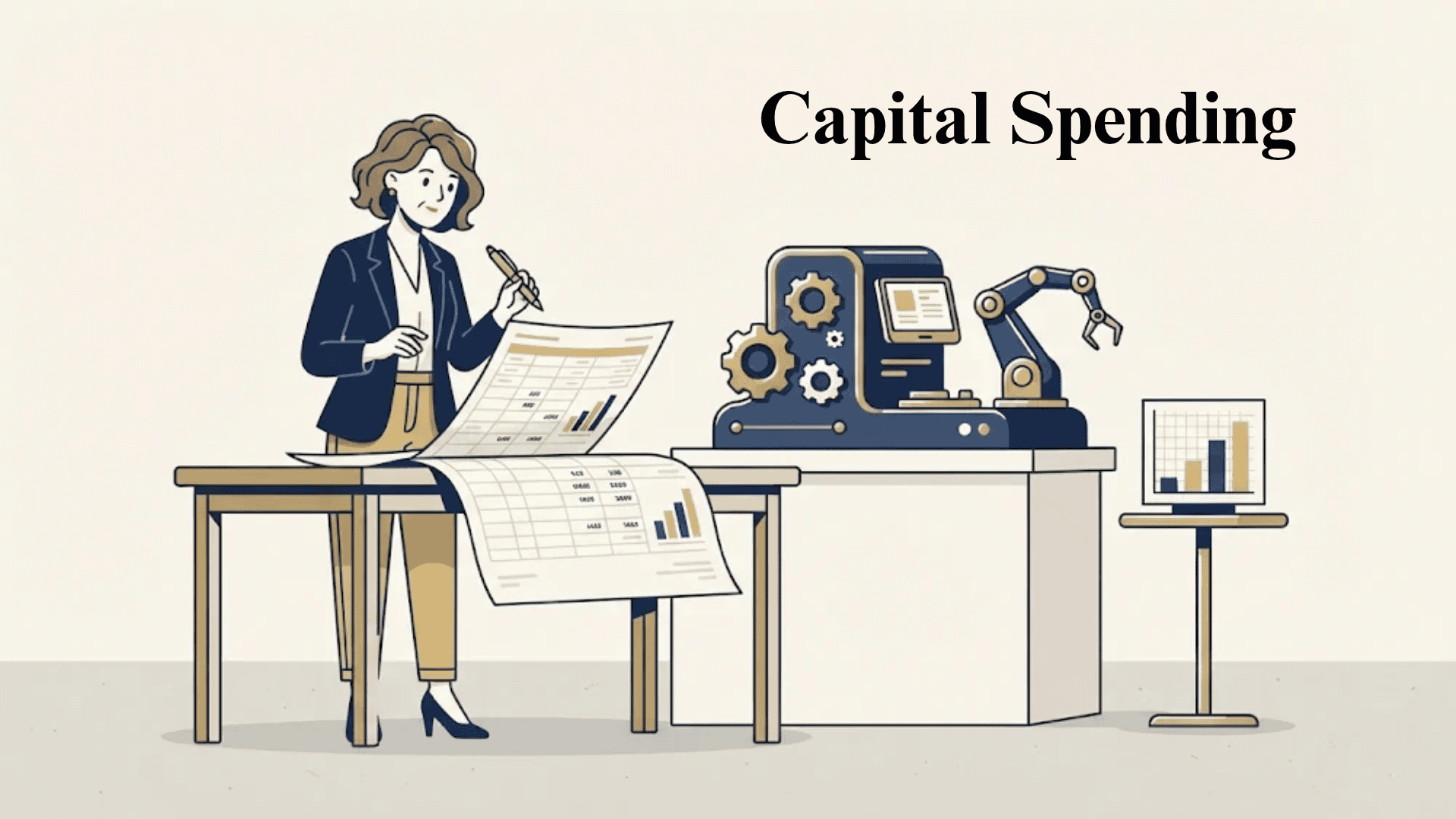
Capital spending, usually called capital expenditure (CapEx), is money a business spends to buy, upgrade, or extend the life of long-term assets such as buildings, machinery, vehicles, equipment, and technology. These assets are expected to benefit the business for more than one year, so their cost is generally recorded as an asset and spread over time through depreciation instead of being treated as a one-time expense.
Understanding capital spending matters whether you run a small business, read financial statements as an investor, or manage a budget. It affects cash flow, profit, taxes,s and growth plans. This guide explains the meaning, gives examples, shows the formula with a worked calculation, covers how US tax rules treat it, and points out where the line between capital and operating costs gets blurry.
Table of Contents
- Capital Spending at a Glance
- What Counts as Capital Spending?
- Common Examples
- What Is Usually Not Capital Spending
- Capital Expenditure vs Operating Expenditure
- How Capital Spending Appears in Financial Statements
- The CapEx Formula With a Worked Example
- Illustrative Calculation
- Types of Capital Spending
- Capital Spending and Taxes in the United States
- How Businesses Decide Whether to Make a Capital Investment
- Why Investors Watch Capital Spending
- Advantages and Risks of Capital Spending
- Advantages
- Risks
- A Hypothetical Small Business Example
- Frequently Asked Questions
- What is capital spending in simple terms?
- Is capital spending the same as CapEx?
- What is the CapEx formula?
- Is capital spending an expense?
- What is the difference between CapEx and OpEx?
- Are software and leases capital spending?
- Conclusion
Capital Spending at a Glance
| Item | Summary |
|---|---|
| Also called | CapEx, capital expenditure, purchases of property, plant and equipment (PP&E) |
| What it buys | Long-term assets that last longer than one year |
| How it is recorded | As an asset on the balance sheet, then depreciated over time |
| Where it shows up | Cash flow statement, under investing activities |
| Opposite concept | Operating expenses (OpEx), the day-to-day costs of running a business |
What Counts as Capital Spending?
Capital spending covers money used to acquire, upgrade, de or maintain physical assets, including property, buildings, equipment, ent and technology. Financial statements may label it “purchases of property, plant and equipment,” “capital spending,” or “asset acquisitions.” The term “capital spending” is also used for governments, where it refers to investment in infrastructure such as roads and schools. In this article,icle we focus on business spending.
Common Examples
- Land and buildings, including purchases and major renovations.
- Machinery and production equipment, such as an oven in a bakery or a printing press.
- Vehicles used in the business.
- Computers and technology hardware, and in some cases software.
- Furniture and fixtures for an office or store.
- Improvements that extend an asset’s useful life or increase its capacity.
What Is Usually Not Capital Spending
- Salaries, benefits,efits and payroll.
- Rent and utilities.
- Routine repairs and maintenance that keep an asset working as it is.
- Marketing, office supplies,s and similar recurring costs.
These are operating expenses, which are generally deducted in the period they occur. Our guide to CapEx vs OpEx goes deeper on the comparison.
Capital Expenditure vs Operating Expenditure
| Factor | Capital expenditure (CapEx) | Operating expense (OpEx) |
|---|---|---|
| Purpose | Acquire or improve long-term assets | Run the day-to-day |
| Time horizon | Benefits last beyond one year | Used up in the current period |
| Accounting | Recorded as an asset, then depreciated | Expensed on the income statement |
| Typical size | Larger, less frequent | Smaller, recurring |
| Examples | Equipment, vehicles, buildings | Payroll, rent, utilities, repairs |
Gray areas exist. A repair that merely restores an asset to working order is generally an expense, while an upgrade that extends its life or improves its capacity is more likely to be capitalized. Equipment leases and software subscriptions can also be treated differently depending on the contract, accounting standards, and tax rules. When the classification is unclear, ask a qualified accountant.
How Capital Spending Appears in Financial Statements
- Balance sheet. The asset is added to property, plant, and equipment (PP&E), and its value decreases over time as depreciation accumulates.
- Income statement. Instead of the full purchase price hitting profit at once, a portion is recognized each year as depreciation expense.
- Cash flow statement. The cash paid is typically shown under investing activities.
This is why a large purchase can reduce cash a lot while reducing reported profit only gradually.
The CapEx Formula With a Worked Example
If you only have a balance sheet and income statement, you can estimate CapEx like this:
CapEx = (Current period net PP&E − Prior period net PP&E) + Depreciation expense
Illustrative Calculation
The numbers below are hypothetical and for illustration only.
| Item | Amount |
|---|---|
| Net PP&E, end of this year | $500,000 |
| Net PP&E, end of last year | $450,000 |
| Depreciation expense this year | $30,000 |
| Estimated CapEx | ($500,000 − $450,000) + $30,000 = $80,000 |
The logic: net PP&E rose by $50,000 even after $30,000 of depreciation reduced it, so the company must have added about $80,000 of assets.
A caution. This formula is an estimate. Asset sales, write-downs, and acquisitions can distort it. If you have the cash flow statement, look for the line labeled purchases of property, plant and equipment, which shows the actual figure.
Types of Capital Spending
Analysts often separate capital spending by purpose. These labels are common in practice, though companies do not always report them separately.
- Maintenance CapEx: replacing or refreshing assets to keep operations running at the current level.
- Growth CapEx: adding capacity or entering new markets, such as a new factory or a second location.
Capital Spending and Taxes in the United States
This section applies to US federal tax rules for tax year 2026, and other countries have their own systems of capital allowances and depreciation. Tax rules change, so verify current figures with the IRS or a tax professional before relying on them.
Capitalized assets are usually recovered through depreciation, but US businesses have several ways to deduct costs faster:
| Method | What it does | 2026 figure reported by tax sources |
|---|---|---|
| De minimis safe harbor | Lets a business expense low-cost items instead of capitalizing them, if it follows the election rules | $2,500 per item or invoice, or $5,000 for businesses with an applicable financial statement |
| Section 179 expensing | Lets a business deduct the cost of qualifying equipment in the year it is placed in service, subject to limits | Up to $2,560,000, with the phase-out beginning at $4,090,000 of purchases |
| Bonus depreciation | Allows an immediate deduction of a percentage of the cost of eligible property | 100% for qualified property acquired after January 19, 2025, following the One Big Beautiful Bill Act |
| Regular depreciation (MACRS) | Spreads the deduction over the asset’s recovery period | Varies by asset class |
Qualifying assets, income limits, vehicle caps,s and state rules all affect what a business can actually deduct. Depreciation and Section 179 elections are reported on IRS Form 4562. For the official rules, see the IRS publication on how to depreciate property (Publication 946). Because tax rules are detailed and change often, this article is not tax advice, and you should consult a licensed tax professional.
How Businesses Decide Whether to Make a Capital Investment
- Define the need. Replace a worn-out asset, increase capacity, ty or reduce costs?
- Estimate the full cost. Include purchase price, installation, training, ing and ongoing maintenance.
- Estimate the benefit—more sales, lower operating costs,osts or avoided downtime.
- Test the return. Common tools include payback period (how long to recover the cost) and net present value (the value of future benefits in today’s money).
- Check funding. Cash, a loan, a lease, or a mix. Consider the effect on cash flow.
- Compare alternatives. Buying, leasing, or renting. Demand may fall, technology may change, and costs may rise.
Finance teams often build these decisions into annual budgets and long-range plans. If you want to understand how capital planning fits into a wider planning process, see our introduction to integrated business planning.
Why Investors Watch Capital Spending
For public companies, CapEx tells investors how much is being reinvested in the business. Some points to keep in mind:
- High CapEx is not automatically good or bad. It can signal growth investment, or it can signal an asset-heavy business that always needs heavy reinvestment.
- Compare to depreciation. If spending is consistently below depreciation, a company may be under-investing in its asset base.
- Free cash flow. A common measure is operating cash flow minus capital expenditure, which shows cash left after reinvestment.
- Industry matters. Utilities, manufacturers, and airlines usually spend more on assets than software or consulting companies.
This is general education, not investment advice.
Advantages and Risks of Capital Spending
Advantages
- Can raise capacity, quality,y or efficiency.
- May lower operating costs over time, for example with more efficient equipment.
- Builds assets that can support growth.
- May bring tax benefits through depreciation or expensing rules.
Risks
- Large upfront cash outflow that can strain liquidity.
- Returns are uncertain and may take years.
- Assets can become obsolete.
- Debt financing adds interest and repayment obligations.
- Misclassifying CapEx and OpEx can distort financial statements and tax filings.
A Hypothetical Small Business Example
This example is hypothetical and for illustration only.
A small bakery has an old oven that keeps breaking down. In March, ch it pays $600 to fix a heating element. That repair keeps the oven working as before, so it is typically an operating expense. In September, ber the owner buys a new, more efficient oven for $18,000, including installation. That is capital spending, because the oven will serve the business for years. Instead of treating the full $18,000 as an expense in one month, the bakery records it as equipment and recovers the cost through depreciation or a tax deduction, depending on the rules that apply and the choices the owner and accountant make. The owner also checks the cash position first, since $18,000 leaving the bank account in one go can strain a small business even if the purchase is a good investment.
Frequently Asked Questions
What is capital spending in simple terms?
It is money a business spends on long-lasting assets, such as equipment, vehicles,cles or buildings, that will benefit the business for more than one year.
Is capital spending the same as CapEx?
Yes. Capital spending, capital expenditure,iture and CapEx are generally used to mean the same thing.
What is the CapEx formula?
A common estimate is the change in net property, plant and equipment plus depreciation expense. If you have a cash flow statement, the purchases of PP&E line gives the actual figure.
Is capital spending an expense?
Not in the full amount at the time of purchase. It is usually recorded as an asset and expensed gradually through depreciation, although some tax rules allow faster deductions.
What is the difference between CapEx and OpEx?
CapEx buys or improves long-term assets, while OpEx covers everyday running costs such as payroll, rent, and utilities.
Are software and leases capital spending?
It depends. Purchased or developed software may be capitalized in some cases, while subscriptions are usually operating costs. Lease treatment depends on the contract and accounting standards, so check with an accountant.
Conclusion
Capital spending is how businesses invest in the assets that let them produce, grow, and compete. The key ideas are simple: it buys long-term assets, it is recorded on the balance sheet and depreciated over time, and it shows up in the cash flow statement under investing activities. The harder part is judgment, including what to capitalize, how to fund it,t and whether the return justifies the cost.
Next step: list the equipment and improvements you expect to buy in the next 12 months, mark which are likely CapEx and which are likely repairs, and review the list with your accountant before you purchase, especially if tax deductions are part of your plan.
This article is for general educational purposes only and is not tax, accounting legalg, legal, or investment advice. Tax rules and thresholds change and differ by country, so confirm current figures with the relevant tax authority or a qualified professional.