
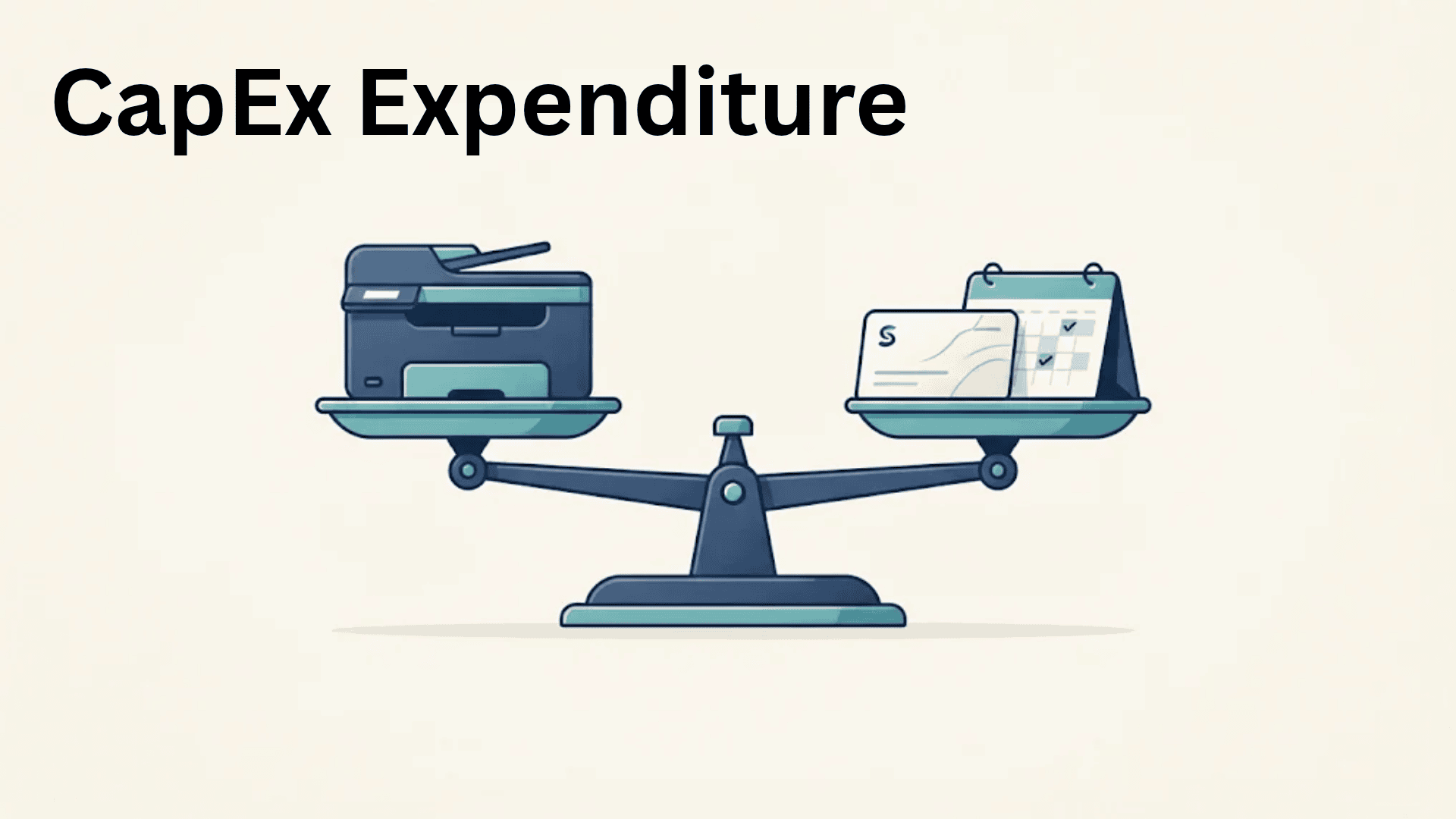
CapEx expenditure is money a business spends to buy or improve long-term assets, such as equipment, vehicles, buildings, or technology that will serve the company for more than a year. OpEx (operating expenditure) is the everyday cost of running the business, such as rent, payroll, utilitie,s and subscriptions. The main difference is time: CapEx builds something that lasts, while OpEx is used up in the course of normal operations.
For a small business, the distinction is more than an accounting label. It shapes your cash flow, your reported profit, your tax deductio,ns and whether you should buy, le,ase or subscribe. This guide explains the differences, shows where the line gets blurry, and gives you a practical way to decide.
Table of Contents
- CapEx vs OpEx at a Glance
- What Is CapEx Expenditure?
- What Is OpEx?
- A Quick Test: Is It CapEx or OpEx?
- Where the Line Gets Blurry
- Repairs vs Improvements
- Software: Buying vs Subscribing
- Leasing
- Small Purchases
- How Each One Affects Your Financial Statements
- A Hypothetical Comparison
- Tax Treatment: A Brief Overview
- Buy, Lease or Subscribe: Comparing Your Options
- A Hypothetical Total Cost Example
- How to Decide: A Practical Framework
- Common Mistakes to Avoid
- Frequently Asked Questions
- What is the main difference between CapEx and OpEx?
- Is rent CapEx or OpEx?
- Is software CapEx or OpEx?
- Are repairs CapEx or OpEx?
- Is leasing CapEx or OpEx?
- Which is better for a small business, CapEx or OpEx?
- Conclusion
CapEx vs OpEx at a Glance
| Factor | CapEx (capital expenditure) | OpEx (operating expenditure) |
|---|---|---|
| Purpose | Acquire or improve long-term assets | Keep the business running day to day |
| Benefit period | More than one year | Current period |
| Balance sheet | Recorded as an asset, then depreciated | Not recorded as an asset |
| Income statement | Depreciation expense spread over years | Expense recognized when incurred |
| Cash flow statement | Investing activities | Operating activities |
| Typical tax treatment (US) | Depreciated over time, unless an expensing option applies | Usually deducted in the year incurred |
| Examples | Equipment, vehicles, fit-outs, owned buildings | Rent, utilities, payroll, marketing, subscriptions |
What Is CapEx Expenditure?
CapEx, or capital expenditure, covers funds used to acquire, upg,rade and maintain physical assets such as property, buildings, equipment or technology. These purchases are expected to produce value beyond a single year, so the cost is generally recorded in the property, plant and equipment (PP&E) section of the balance sheet and reduced over time through depreciation.
Companies often distinguish between maintenance CapEx, which keeps existing operations going, and growth CapEx, which expands the business through new equipment or new locations. For a full explanation, including the formula, see our guide to capital spending.
What Is OpEx?
OpEx covers the recurring costs of keeping the business operating. Typical examples include:
- Salaries and payroll costs
- Rent and utilities
- Marketing and advertising
- Software subscriptions and cloud services
- Routine repairs and maintenance
- Equipment lease payments (with an important caveat covered below)
These costs hit your income statement in the period they occur, which means they reduce profit right away.
A Quick Test: Is It CapEx or OpEx?
When you are unsure, ask these questions:
- Will it benefit the business for more than a year? If yes, it may be CapEx.
- Do I own it, or does it add to something I own? Ownership and improvement point to CapEx.
- Is it a recurring cost of normal operations? If yes, it is likely OpEx.
- Does it just keep an asset working as before? Routine repairs are usually OpEx. Upgrades that extend life or capacity are more likely CapEx.
This test gives a starting point, not a final ruling. Accounting standards and tax rules decide the actual treatment, so confirm anything significant with your accountant.
Where the Line Gets Blurry
Repairs vs Improvements
Fixing a broken part is normally an operating expense. Replacing an engine or adding capacity usually counts as capital spending because it extends the asset’s life or improves its capability.
Software: Buying vs Subscribing
How you acquire software changes its treatment. Cloud software paid for through a monthly or annual subscription is generally OpEx, while an on-premises license bought outright has traditionally been treated as CapEx. Prepaying several years of a subscription may be recorded as a prepaid expense and expensed over the contract term, which sits between the two categories. Software accounting depends on contract terms, region and tax law, so this area needs professional input.
Leasing
Leasing is often described as converting CapEx into OpEx, because you pay in installments rather than buying outright. That is a useful simplification for cash flow, but it is not the whole story. Under modern lease accounting standards, such as IFRS 16 and ASC 842, many leases must be recorded on the balance sheet as an asset and a liability. Small businesses that follow simplified accounting or cash-basis rules may be treated differently. Ask your accountant how your leases will actually be recorded and taxed.
Small Purchases
Many businesses set a capitalization threshold, below which items are simply expensed. In the US, the de minimis safe harbor election lets eligible businesses deduct items up to a set amount per item or invoice instead of capitalizing them. Check the current limits with the IRS or a tax professional.
How Each One Affects Your Financial Statements
A Hypothetical Comparison
The numbers below are hypothetical and simplified. They ignore taxes and any special expensing rules.
Suppose a small business spends $12,000 in January.
| Treated as CapEx (equipment lasting 5 years) | Treated as OpEx (one-year expense) | |
|---|---|---|
| Cash paid in year 1 | $12,000 | $12,000 |
| Expense on income statement in year 1 | $2,400 (straight-line depreciation over 5 years) | $12,000 |
| Effect on year 1 profit | Lower by $2,400 | Lower by $12,000 |
| Balance sheet | Asset of $9,600 remaining at year-end | No asset |
Cash leaves the bank in the same amount either way. What changes is when the cost shows up in profit. Misclassifying a routine expense as CapEx can overstate profit, so accurate categories matter, especially if you have lenders or investors who read your statements.
Tax Treatment: A Brief Overview
In the United States, operating expenses are generally deductible in the year you incur them, while capital expenditures must be depreciated over time unless you qualify for options such as Section 179 expensing or bonus depreciation. Our capital spending guide lists the 2026 figures reported by tax sources, but verify them with the IRS or a tax professional before you rely on them.
Other countries use different systems. In the UK and several other jurisdictions, for example, tax relief on capital purchases typically comes through capital allowances. Always check the rules for your country, state or province.
Buy, Lease or Subscribe: Comparing Your Options
| Option | Upfront cash | Ownership | Flexibility | Main risk |
|---|---|---|---|---|
| Buy (CapEx) | High | You own the asset | Lower | Tied-up cash; obsolescence |
| Lease | Low | Usually not, unless a buyout applies | Medium | Total cost may exceed buying; contract terms |
| Subscribe or rent (OpEx) | Low | None | High | Ongoing costs; price changes; no asset built |
Industry commentary generally says renting or subscribing offers flexibility and lower initial risk, and it explains why many small businesses now choose cloud software over on-premises systems. It also warns that “cloud is good because it shifts CapEx to OpEx” is too simple, since the right choice depends on how you finance and use the technology.
A Hypothetical Total Cost Example
This example is hypothetical and for illustration only.
A small design studio needs specialized equipment. It can buy it for $6,000, or lease it at $180 a month for 36 months, which totals $6,480. The lease preserves $6,000 of cash today and may include support, but costs $480 more over three years. If the equipment would be obsolete in three years, the lease may be a better deal. If it would last eight years, buying is likely cheaper. A real comparison should also include maintenance, insurance, financing costs, tax effects and resale value.
How to Decide: A Practical Framework
- Check your cash position. Can you pay upfront without risking day-to-day operations?
- Estimate the useful life. The longer an asset will be useful, the more buying tends to make sense.
- Compare total cost over the full period, not just the monthly payment.
- Consider technology risk. Fast-changing equipment favors leasing or subscribing.
- Review tax effects with a professional, including expensing options and capital allowances.
- Consider growth plans. If you may scale up or down, flexibility has value.
- Read the contract. Look for early termination fees, auto-renewals and end-of-term obligations.
Most small businesses end up with a mix of both. Neither approach is inherently better. OpEx tends to preserve cash and flexibility, while CapEx can be cheaper over the long run and may qualify for tax relief.
Common Mistakes to Avoid
- Letting the tax deduction drive the decision. A purchase you do not need is not a saving.
- Ignoring total cost. Low monthly payments can hide a higher overall price.
- Misclassifying expenses. Putting routine costs in CapEx can inflate profit.
- Forgetting maintenance and upgrades when comparing buy versus lease.
- Assuming a lease stays off your books. Accounting standards may require it to be recorded.
- Not keeping records. Invoices, asset registers and contracts support both your accounts and your tax return.
Frequently Asked Questions
What is the main difference between CapEx and OpEx?
CapEx buys or improves long-term assets that benefit the business for more than a year. OpEx covers the regular costs of running the business. CapEx is depreciated over time, while OpEx is expensed when incurred.
Is rent CapEx or OpEx?
Rent is generally OpEx. Buying a building, however, is CapEx. Long-term lease accounting can be more complex, so check with your accountant.
Is software CapEx or OpEx?
It depends on how you acquire it. A subscription is usually OpEx, while an on-premises license bought outright has traditionally been treated as CapEx. Contract terms and accounting rules can change this.
Are repairs CapEx or OpEx?
Routine repairs that keep an asset working are normally OpEx. Improvements that extend an asset’s life or increase its capacity are more likely CapEx.
Is leasing CapEx or OpEx?
Leasing is often described as OpEx, but under standards such as IFRS 16 and ASC 842, many leases are recorded on the balance sheet. The treatment depends on your accounting framework and the lease terms.
Which is better for a small business, CapEx or OpEx?
Neither is better in every case. OpEx offers flexibility and preserves cash, while CapEx may cost less over the long term and can offer tax benefits. Many businesses use both.
Conclusion
CapEx expenditure builds assets that last, and OpEx pays for the ongoing work of running the business. The labels matter because they change how your spending appears in your accounts, how it is taxed and how much cash you have available. The smartest choice for a small business is rarely the cheapest monthly payment or the biggest deduction. It is the option that fits your cash flow, the useful life of the asset and your growth plans.
Next step: take your three largest recurring or planned purchases, label each as CapEx, OpEx or unclear using the quick test above, and bring the unclear ones to your accountant before you commit to buy, lease or subscribe.
This article is for general educational purposes only and is not tax, accounting, legal or financial advice. Accounting standards, tax rules and thresholds change and differ by country, so confirm the treatment of your own purchases with a qualified professional.