

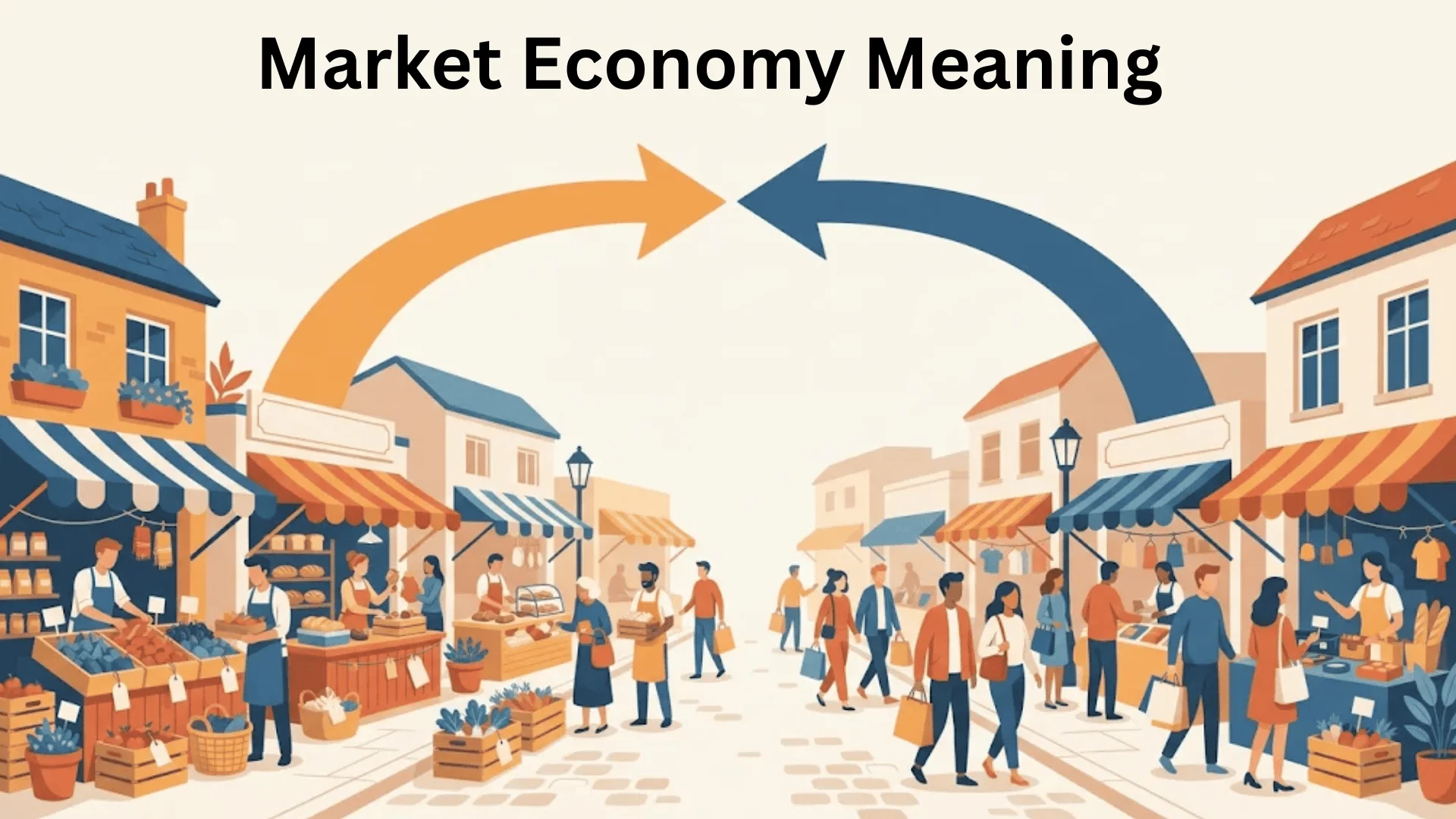
A market economy is an economic system in which decisions about what to produce, how much to produce, and what to charge are guided mainly by supply and demand, rather than by a central authority. Businesses and individuals decide what to buy, sell, and invest in, and prices act as signals that tell producers what customers want and how scarce something is.
The term sounds academic, but it affects everyday business decisions: how you price a product, how you respond to a new competitor, why your costs change, and where rules andregulationsn fit in. This guide explains the market economy meaning in plain English, how it differs from command and mixed economies, its strengths and weaknesses, and what it means in practice for business owners. It also covers the main misconceptions, such as the idea that a market economy means “no rules.”
Table of Contents
- Market Economy Meaning at a Glance
- How a Market Economy Works
- A Hypothetical Example
- Key Characteristics of a Market Economy
- Market Economy vs Command Economy vs Mixed Economy
- Is Any Economy Purely a Market Economy?
- The Role of Government: Different Views
- Advantages of a Market Economy
- Disadvantages and Criticisms
- Common Misconceptions
- What a Market Economy Means for Business Owners
- Frequently Asked Questions
- What is the simple meaning of a market economy?
- What are the main features of a market economy?
- What is the difference between a market economy and a command economy?
- What is a mixed economy?
- Is the United States a market economy?
- What are the pros and cons of a market economy?
- Conclusion
Market Economy Meaning at a Glance
| Item | Summary |
|---|---|
| Definition | An economy where investment, producti,on and distribution are guided largely by prices set through supply and demand |
| Who decides | Many decentralized buyers, sellers and businesses |
| Ownership | Mostly private, in the classic description |
| Role of competition | Central: it pushes businesses to improve quality and prices |
| Role of government | Varies by country and view: from minimal to a more active regulatory role |
| Opposite model | Command (centrally planned) economy |
How a Market Economy Works
In a market economy, millions of separate decisions combine to answer three basic questions: what gets produced, how it is produced, and who receives it. Instead of a planner deciding, signals from the market guide the choices.
- Customers express demand by choosing what to buy and how much to pay.
- Businesses respond with supply, making and selling goods or services they expect to be profitable.
- Prices adjust. When demand rises faster than supply, prices tend to rise. When supply exceeds demand, prices tend to fall.
- Resources shift. Higher prices and profits attract more producers and investment. Falling prices and losses push resources elsewhere.
- Competition keeps pressure on. Businesses that serve customers better or at lower cost tend to gain share, while others must adapt or exit.
When the amount supplied matches the amount demanded at a given price, the market is said to be in equilibrium. Real markets are rarely perfectly balanced, but prices constantly push them in that direction.
A Hypothetical Example
This example is hypothetical and for illustration only.
Imagine a small town with two coffee shops. A large office opens nearby, and demand for morning coffee jumps. Lines get longer, and one shop raises prices slightly without losing many customers. Seeing the profits, a third entrepreneur opens a new shop. With more supply, customers have more choice, and prices stop rising as the shops compete on quality, speed and loyalty rewards. Nobody planned that outcome. It emerged from prices, profits and competition. If the office later closes, demand falls and one shop may close, freeing up its space and staff for other uses.
Key Characteristics of a Market Economy
- Private property and private enterprise. Individuals and businesses own resources and can earn profits from them.
- Prices set by supply and demand. Prices communicate scarcity and preferences.
- Competition. Multiple producers compete for customers, which pushes toward efficiency and innovation.
- Decentralized decision-making. Decisions are spread across many participants rather than set by a central plan.
- Consumer choice. Buyers decide what to purchase, and their choices shape what gets produced.
- Self-interest and incentives. Profit and personal gain motivate production and investment.
- A framework of rules. Markets rely on laws such as property rights and contract enforcement, even where government intervention is limited.
The IMF’s explanation of capitalism lists similar pillars: private property, self-interest and a limited role for government, mainly to protect citizens’ rights and maintain an orderly environment in which markets can function.
Market Economy vs Command Economy vs Mixed Economy
| Feature | Market economy | Command (planned) economy | Mixed economy |
|---|---|---|---|
| Who makes economic decisions | Individuals and businesses | Central government planners | A combination of both |
| Ownership | Mostly private | Mostly state or collective | Both private and state-owned enterprises |
| Prices | Set mainly by supply and demand | Often set by the government | Mostly market-set, with some regulation or controls |
| Competition | Central feature | Limited | Present, often with rules to protect it |
| Government role | Protect rights and enforce rules | Directs production | Regulates markets, corrects failures, provides services |
A fourth type, the traditional economy, is based on custom and inherited roles rather than price signals or central plans. It is found in some small, often rural communities.
Is Any Economy Purely a Market Economy?
Economists generally say that most real-world economies are mixed. They combine market forces with some degree of government involvement. Economics textbooks describe the US economy as positioned toward the market-oriented end of the spectrum, while citing North Korea and Cuba as examples of command economies. Other educational sources list countries such as the United States, Canada, the United Kingdom and Denmark as market economies. These labels are simplifications, because countries differ widely in taxation, regulation, public services and state-owned industry, and experts disagree on where to draw the lines.
The IMF notes that “free markets,” or laissez-faire economies, operate with little or no regulation, while in mixed economies markets play the dominant role but government regulates to correct market failures such as pollution and congestion, promote social welfare and support other goals such as defense and public safety.
The Role of Government: Different Views
How much government involvement is best is one of the most debated questions in economics and politics. Here is a neutral summary of the main perspectives, without taking a side.
- Minimal-intervention view. Supporters argue that government should mostly protect property rights and enforce contracts, leaving the rest to markets. They say this maximizes freedom and innovation and avoids the mistakes of central planners.
- Regulated or mixed-market view. Supporters argue that markets work best with rules that fix failures such as pollution, monopoly power or lack of information, and with public provision of goods that markets under-supply, such as defense or basic infrastructure.
- Welfare-oriented view. Supporters argue that governments should also address inequality and provide a safety net, since market outcomes alone may leave some people behind.
Business owners operate within whichever mix their country has chosen, and the rules change over time. Understanding the framework helps you plan for taxes, regulation, labor rules and competition.
Advantages of a Market Economy
- Efficiency. Competition encourages businesses to use resources well and keep costs down.
- Innovation. The prospect of profit rewards new products and better methods.
- Consumer choice. Businesses compete to meet what customers want.
- Flexibility. Prices and production can adjust quickly to changing conditions without waiting for a central plan.
- Entrepreneurial opportunity. Individuals can start businesses and keep the rewards, which is why market economies are often associated with strong startup activity.
Disadvantages and Criticisms
- Inequality. Competition can produce wide gaps in income and wealth, and the market may end up reflecting the preferences of the most successful rather than society at large.
- Market failures. Pollution, monopolies and under-provision of public goods are cases where unregulated markets may not produce good outcomes.
- Instability. Booms and busts, unemployment and financial crises can occur.
- Unequal information and power. Buyers and sellers do not always have equal information or bargaining strength, which is one reason consumer protection laws exist.
- Essentials depend on demand. Goods that are costly to provide, such as basic services in remote areas, may be harder to supply on market terms alone.
Supporters of market economies often reply that they generate the wealth that funds solutions, that government intervention has its own failures, and that many of these problems can be tackled with targeted rules rather than central control. Critics reply that some problems are structural. Economists continue to debate these trade-offs.
Common Misconceptions
- “A market economy means no rules.” Markets depend on law, such as property rights, contracts and courts. Even strongly market-oriented systems have some regulation.
- “Market economy and capitalism are identical.” They overlap, but the terms are not always interchangeable. Some economists point out that markets do not logically require private ownership of all production, and that capitalism describes a broader social and economic system.
- “A market economy and a free market are the same.” A free market, or laissez-faire economy, is an extreme version with little regulation. Most market economies today are mixed.
- “Prices always reflect true value.” Prices reflect what buyers will pay and sellers will accept, which can differ from what is fair or what a product costs society.
- “Government and markets are opposites.” In practice, they interact constantly, and most economies use both.
What a Market Economy Means for Business Owners
- Pricing is shaped by the market. You set prices, but customers and competitors limit what works. Study the market rather than relying on cost alone.
- Competition is a given. Expect rivals to respond to your successes. A regular SWOT analysis helps you track where you are strong and where you are exposed.
- Your legal structure matters. Raising capital often means choosing a form such as a corporation or joint-stock company. See our guide to the joint-stock company for how share-based businesses work.
- Costs and demand can change quickly. Build flexibility into contracts, inventory and staffing where you can.
- Rules still apply. Tax, labor, consumer protection and competition laws differ by country, so check what applies to your business.
- Risk and reward are linked. Market incentives reward success but also allow failure. Plan finances accordingly.
Frequently Asked Questions
What is the simple meaning of a market economy?
It is an economy in which supply and demand, expressed through prices, guide what is produced and sold, rather than a central authority deciding.
What are the main features of a market economy?
Private property and enterprise, prices set by supply and demand, competition, decentralized decisions, consumer choice and a legal framework to protect property and contracts.
What is the difference between a market economy and a command economy?
In a market economy, individuals and businesses make most decisions and prices are set by supply and demand. In a command economy, the government owns major resources and decides what to produce and often what to charge.
What is a mixed economy?
A mixed economy combines market forces with government involvement. Markets play a major role, but governments regulate, provide services and sometimes own enterprises. Most real-world economies fall into this category.
Is the United States a market economy?
Educational sources commonly describe it as market-oriented, and also as a mixed economy because government regulates and provides some goods and services. The label depends on the definition used.
What are the pros and cons of a market economy?
Pros usually cited include efficiency, innovation, choice and flexibility. Cons include inequality, market failures, instability and uneven access to essentials. People disagree about how serious each is and how best to address them.
Conclusion
A market economy is a system where supply, demand and competition, not a central plan, guide most economic choices. In practice, almost every modern economy is a blend of markets and government, and the real debate is about the mix. For business owners, the practical lessons are to understand your customers and competitors, price with the market in mind, and stay aware of the rules that shape your industry.
Next step: write down who your three closest competitors are, how your prices compare to theirs and what would change if a new rival entered tomorrow. Then update your plans to match what you find.
This article is for general educational purposes only. It describes economic concepts and different viewpoints and does not endorse any political position or provide investment, legal or tax advice. Laws and economic policies differ by country and change over time.