
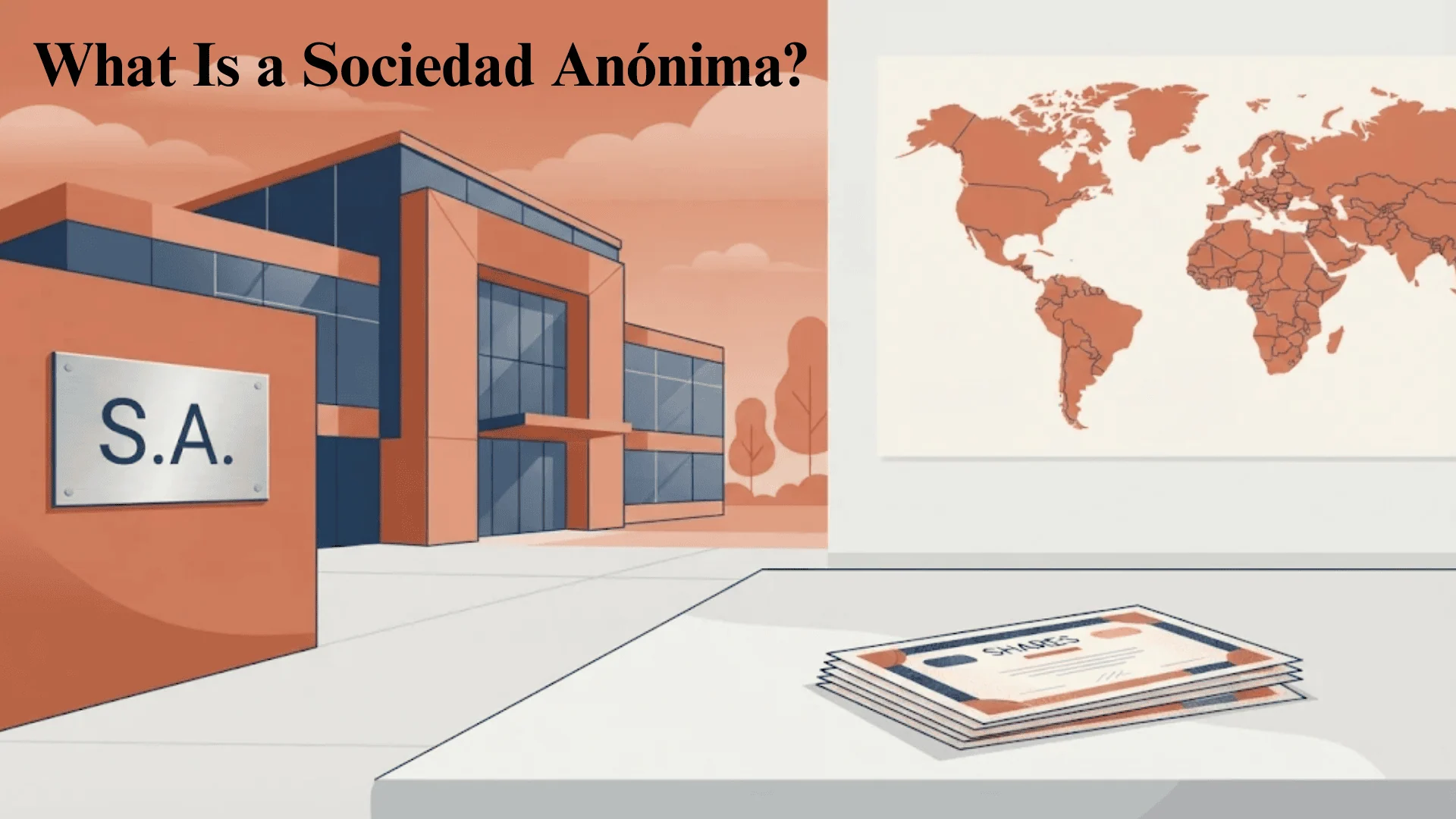
A sociedad anónima (also written sociedad anonima without the accent) is a type of company whose capital is divided into shares and whose shareholders are liable only up to what they contributed. The abbreviation is S.A., and it appears after a company’s name, much like “Inc.” or “plc” in English-speaking countries. It is the Spanish version of a form that exists in many countries, including the French société anonyme and the Portuguese sociedade anónima.
If you have seen “S.A.” on an invoice, a contract, or a company website and wondered what it means, this guide explains it in plain English. It covers how an S.A. works, how it differs from the Spanish S.L., what the variants such as S.A. de C.V. mean, and how to compare it with US and UK company types. Company law differs by country, so treat this as general education, not legal advice.
Table of Contents
- What Is a Sociedad Anónima?
- S.A. at a Glance
- What Does S.A. Mean After a Company Name?
- How a Sociedad Anónima Works
- Sociedad Anónima vs Sociedad Limitada (S.A. vs S.L.) in Spain
- S.A. Variants You Will See
- What Is S.A. Called in Other Countries?
- Advantages and Limitations
- Advantages
- Limitations
- Forming a Sociedad Anónima: A General Overview
- A Hypothetical Example: Reading an Invoice
- Frequently Asked Questions
- What does S.A. stand for?
- Is a sociedad anónima the same as a corporation?
- What is the difference between S.A. and S.L.?
- What does S.A. de C.V. mean?
- Is an S.A. a public company?
- What is the minimum capital for an S.A. in Spain?
- Conclusion
What Is a Sociedad Anónima?
A sociedad anónima is a commercial company whose capital is divided into shares. Each shareholder is liable only up to the amount they contributed, so their personal assets are generally protected from the company’s debts. Like other limited-liability companies, it is a separate legal person: it can own property, sign contracts,s and be sued in its own name.
The word “anónima” means “anonymous.” The usual explanation is that the company is identified by its business activity or name rather than by its owners’ identities, and ownership can change as shares are transferred. It does not mean the owners are secret, and each country generally has registers of companies and shareholders.
S.A. at a Glance
| Item | Summary |
|---|---|
| Full name | Sociedad anónima (Spanish) |
| Abbreviation | S.A. or SA |
| Rough English equivalent | Corporation or public limited company |
| Capital | Divided into shares |
| Owners’ liability | Limited to their contribution |
| Legal status | Separate legal entity |
| Common in | Spain, Latin America, and, as société anonyme, France and Belgium |
What Does S.A. Mean After a Company Name?
When you see S.A. after a business name, it tells you the company’s legal form: it is organized as a share-based limited-liability company. In Mexico, you will often see the longer form S.A. de C.V., as in the names of large Mexican subsidiaries and companies such as Volkswagen de México and América Móvil. The “C.V.” stands for capital variable, explained below.
The suffix helps you identify which country’s law governs the company and what type of entity you are dealing with. It does not tell you whether the company is large, successful,l or publicly traded. In some countries, es an S.A. can be a small private business.
How a Sociedad Anónima Works
- Shares. The share capital is divided into shares (acciones). Shares can be transferred, and in the Spanish version, they are marketable securities that can be listed on a stock exchange.
- Limited liability. Each shareholder’s risk is limited to their contribution.
- Governance. An S.A. is run by a sole director, joint directors,s or a board of directors, depending on the country’s rules and the company’s bylaws. In Spain, if the S.A. has a board, the minimum is three directors.
- Legal framework. In Spain, S.A.s and S.L.s are regulated by the Spanish Companies Act (Ley de Sociedades de Capital, Royal Legislative Decree 1/2010).
- Capital requirements. Many countries require a minimum amount of share capital. See the Spanish figures below.
Sociedad Anónima vs Sociedad Limitada (S.A. vs S.L.) in Spain
In Spain, the two most common company forms are the S.A. and the S.L. (sociedad de responsabilidad limitada). Both have independent legal personality and limited liability. The main differences are below.
| Feature | Sociedad anónima (S.A.) | Sociedad limitada (S.L.) |
|---|---|---|
| Minimum capital | €60,000, with at least 25% paid in at formation | €3,000 in most sources, fully paid in |
| Ownership units | Shares (acciones), which are securities | Participations (participaciones sociales), which are not securities |
| Stock exchange listing | Possible | Not possible |
| Share transfers | Generally freer | More restricted |
| Typical use | Larger businesses and companies seeking outside investors | Small and medium businesses |
| Prevalence | Less common | The most common form in Spain |
One law-firm guide reported that S.L.s made up 99.51% of companies incorporated in Spain in 2017, which shows how rare new S.A.s are by comparison. That figure is dated, so treat it as indicative only.
A note on the S.L. minimum capital. Most professional sources list €3,000, but some Spanish banking sources list a far lower starting figure following recent reforms. Company law changes, so confirm the current minimum with a Spanish lawyer, notary, or the official registry before relying on either number.
S.A. Variants You Will See
| Abbreviation | Meaning | Where | Notes |
|---|---|---|---|
| S.A. | Sociedad anónima | Spain, many Latin American countries | Share-based limited-liability company |
| S.A. de C.V. | Sociedad anónima de capital variable | Mexico | Capital can change without a formal amendment of the bylaws; described by one law firm as similar to a US corporation.n |
| S.A.B. de C.V. | Sociedad anónima bursátil de capital variable | Mexico | For publicly traded companies |
| S.A.P.I. de C.V. | Sociedad anónima promotora de inversión de capital variable | Mexico | A subtype of the S.A. de C.V. |
| S. de R.L. de C.V. | Sociedad de responsabilidad limitada de capital variable | Mexico | Closer to a US LLC than a corporation |
Mexican law recognizes variable capital, so most Mexican S.A.s operate as S.A. de C.V. For a US reader, DLA Piper’s guide describes the S.A. de C.V. as similar to a corporation in the US and the S. de R.L. de C.V. as similar to an LLC.
What Is S.A. Called in Other Countries?
The sociedad anónima is one member of a family of share-based company forms with similar structure and purpose. UK tax authority guidance lists these equivalents.
| Country | Abbreviation | Name |
|---|---|---|
| Spain, Mexico and others | S.A. | Sociedad anónima |
| France, Belgium | S.A. | Société anonyme |
| Brazil | S.A. | Sociedade anônima |
| Netherlands | N.V. | Naamloze vennootschap |
| Germany, Austria, Switzerland | AG | Aktiengesellschaft |
| Switzerland (French-speaking) | S.A. | Société anonyme |
These are comparable but not identical. Rules on capital, governance, taxation, reporting, and shareholder rights differ by country. For a US or UK reader, an S.A. is roughly comparable to a US corporation or a UK public limited company, but the comparison is approximate, and a lawyer in the relevant country should confirm the details of any specific deal.
Advantages and Limitations
Advantages
- Limited liability. Shareholders’ personal assets are generally protected.
- Easier access to capital. Shares can be issued and sold, and in some versions listed on a stock exchange.
- Transferable ownership. Shares can generally change hands more easily than in a closely held company.
- Credibility. The form is widely recognized and suited to larger or investor-backed businesses.
Limitations
- Higher setup capital in countries such as Spain, where an S.A. needs €60,000 against a much lower figure for an S.L.
- More complex rules. Spanish sources describe S.A.s as subject to more demanding legal and administrative requirements than S.L.s.
- Slower incorporation. One law-firm guide from 2020 reported an average of five to six weeks to incorporate an S.A. in Spain. Timing varies and may have changed.
- Not always necessary. Many small businesses choose simpler forms.
Forming a Sociedad Anónima: A General Overview
The process depends on the country, so this is only a general outline. In Spain, forming a company generally involves choosing and registering a name, preparing the bylaws, depositing the required capital, signing a public deed before a notary, and registering the company in the Mercantile Registry (Registro Mercantil). It also involves obtaining a tax identification number and meeting tax registration requirements. Non-monetary contributions to an S.A. may require an independent expert report, according to one law-firm guide.
Because incorporation rules, taxes,s and foreign-ownership requirements are complex, hire a local lawyer or licensed adviser rather than relying on a general article.
A Hypothetical Example: Reading an Invoice
This example is hypothetical. The company name is fictional.
A small US importer receives a quote from “Distribuidora Ejemplo, S.A. de C.V.” Reading the suffix tells the importer that the supplier is a Mexican share-based company with variable capital, that its shareholders’ liability is limited, and that the contract will likely be governed by Mexican commercial law unless the parties agree otherwise. The importer should make sure that the legal name on the contract exactly matches the name in the company registry, confirm who has authority to sign for the company, and ask a lawyer about payment terms and dispute resolution. The suffix is a clue about the legal form, not a guarantee of financial strength.
Frequently Asked Questions
What does S.A. stand for?
In Spanish-speaking countries, S.A. stands for sociedad anónima. In French-speaking countries, it stands for société anonyme. In Portuguese, it is sociedade anónima.
Is a sociedad anónima the same as a corporation?
It is broadly similar: a share-based company with limited liability. But the legal rules differ by country, so it is not identical to a US corporation or a UK plc.
What is the difference between S.A. and S.L.?
In Spain, an S.A. needs more minimum capital, uses freely transferable shares, res and can be listed on a stock exchange. An S.L. is simpler, requires less capital, and is the more common form for small and medium businesses.
What does S.A. de C.V. mean?
It stands for sociedad anónima de capital variable, a common Mexican company type in which the capital can vary within limits set by the company’s bylaws.
Is an S.A. a public company?
Not necessarily. The S.A. form allows shares to be offered to the public and listed in some countries, but many S.A.s are privately held. In Mexico, listed companies use the S.A.B. de C.V. form.
What is the minimum capital for an S.A. in Spain?
Professional sources report €60,000, with at least 25% paid in when the company is formed. Verify the current requirement with an official or professional source before incorporating.
Conclusion
A sociedad anónima is a share-based limited-liability company common in Spain and Latin America, with close relatives in France, Belgium, Brazil, and other countries. The abbreviation S.A. tells you the legal form, which helps you understand who owns the company, how liability works,s and which country’s law is likely to apply. It does not tell you how big or reliable the business is.
Next step: if you are dealing with an S.A. in a contract, check the exact legal name and registration in the country’s company registry before you sign, and have a local lawyer review anything of significant value.
This article is for general educational purposes only and is not legal, tax, tax, tax, or financial advice. Company law, minimum capital rules and tax treatment differ by country and change over time, so consult a qualified lawyer or adviser in the relevant country before forming or contracting with a company.