

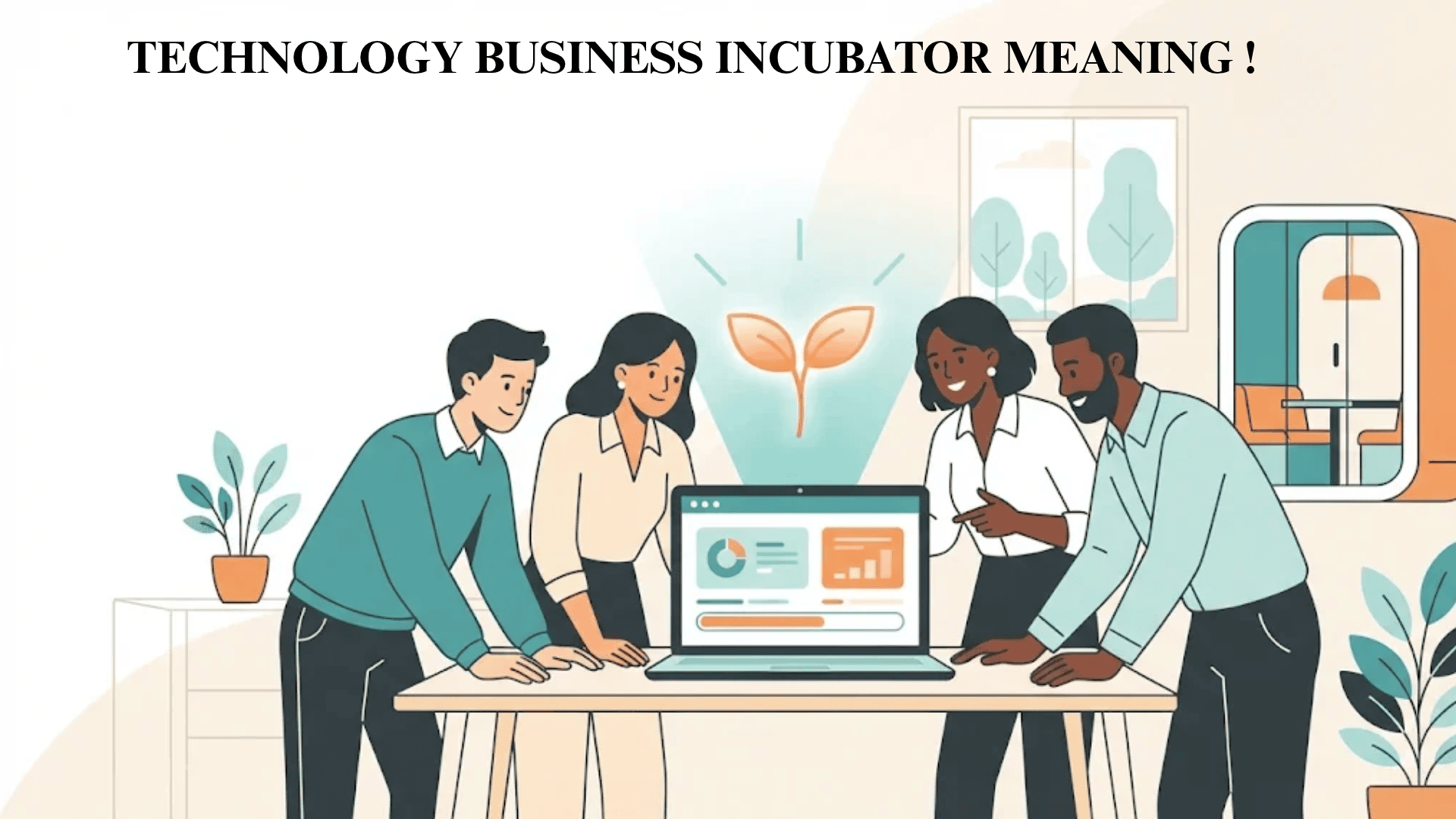
A technology business incubator is a program that helps early-stage technology startups develop their ideas into viable companies by providing resources such as mentoring, workspace, business guidance, and introductions to funders. The word “incubate” is the clue to the meaning: like a device that keeps something fragile warm while it develops, an incubator protects a young company while it finds its footing.
This guide explains the meaning in plain English, what incubators actually offer, how they differ from accelerators, what they may cost, and how to decide whether to apply. It also covers the limits, because an incubator helps some startups and is the wrong fit for others.
Table of Contents
- Technology Business Incubator Meaning in Plain English
- What a Technology Incubator Typically Offers
- Incubator vs Accelerator vs Co-working Space
- How a Technology Business Incubator Works
- What Does an Incubator Cost?
- Advantages and Limitations
- Potential Advantages
- Potential Limitations
- A Note on Survival Statistics
- Is a Technology Incubator Right for You?
- A Hypothetical Example
- How to Join a Technology Business Incubator
- Warning Signs to Watch For
- Frequently Asked Questions
- What does technology business incubator mean?
- What is the difference between an incubator and an accelerator?
- Do incubators take equity?
- How long do startups stay in an incubator?
- Do I need a product to join an incubator?
- How do I find a business incubator near me?
- Is a business incubator worth it?
- Conclusion
Technology Business Incubator Meaning in Plain English
The International Business Innovation Association (InBIA), a global network for entrepreneurship centers, describes an incubator as a business support process that speeds up the development of startups and young companies by providing targeted resources and services. Those services are usually organized by the incubator’s management and offered both on site and through its network of contacts.
A technology business incubator narrows that idea to tech ventures. Depending on the program, that may mean software, hardware, biotech, clean energy, or other research-driven fields. Some incubators focus on one sector. For example, the Youngstown Business Incubator in Ohio has been described as focusing on technology-related companies.
Incubators are usually sponsored by organizations that want to build local business activity, such as universities, economic development agencies, corporations,s and investment firms.
What a Technology Incubator Typically Offers
Every program is different, so always read the specific terms. Common offerings include:
- Mentoring and coaching from experienced founders and industry experts.
- Workspace and equipment, which may include shared offices, labs, bs or prototyping facilities.
- Business support such as help with business planning, accounting basics,ics and legal introductions.
- Training and workshops on topics like customer discovery, pricing and fundraising.
- Networking with other founders, advisors, customers,mers and potential investors.
- Funding introductions. Some incubators connect startups with investors or grants; some provide small amounts of seed money themselves, but this is not universal.
Incubator vs Accelerator vs Co-working Space
These terms are often mixed up. They overlap, but they are not the same.
| Feature | Incubator | Accelerator | Co-working space |
|---|---|---|---|
| Best for | Early ideas that need development and validation | Startups with a product or traction that want to scale fast | Anyone who needs a flexible place to work |
| Typical length | Often 6 months to 2 years | Often 3 to 6 months | No fixed program |
| Structure | Ongoing support, often at your own pace | Intensive, cohort-based, ending in a demo day | Space and community, usually no program |
| Funding | Varies; often little or none directly | Often small seed funding in exchange for equity | Membership fee |
| Selection | Varies, often more accepting than accelerators | Usually highly competitive | Open to anyone who pays |
The U.S. Small Business Administration’s research office has noted that incubators and accelerators provide similar services but are different kinds of organizations. As a rule of thumb, an incubator helps you build and validate the idea, while an accelerator helps you scale something that already works.
Timeframes and terms vary by program, so treat these as typical ranges rather than rules. Older research from Northwestern’s Kellogg School described accelerators giving seed money in return for a single-digit percentage of equity, often cited as roughly 5 to 7 percent. That figure is dated and varies widely today, so always read the terms.
How a Technology Business Incubator Works
- Application. You submit your idea, team background, and goals. Many programs look for early-stage companies that have launched or are about to.
- Selection. The incubator reviews fit. Some are open to many founders, while higher-profile programs can be selective.
- Onboarding. You agree on terms, which may cover fees, equity, services,rvices and expectations.
- Development. You work with mentors, use the space and resources, and build toward milestones such as a prototype, first cu,stomers or a funding round.
- Graduation. When the company is ready, it leaves the program. Reports suggest many incubators expect companies to stay for up to about two years, though this differs by program.
What Does an Incubator Cost?
There is no single price. Depending on the program, you might encounter:
- No fee, especially in programs funded by universities, governments,ernments or nonprofits.
- Rent or membership fees for workspace and services.
- Equity, where the incubator takes a share of your company in exchange for support.
- A mix of fees and equity.
Before you sign anything, ask what you are giving up, for how long, and what happens if you leave early. Because equity and contract terms can affect your company for years, have a lawyer review any agreement. This is general information, not legal advice.
Advantages and Limitations
Potential Advantages
- Lower startup overhead. Shared space and services reduce early costs.
- Guidance. Mentors can help you avoid common mistakes.
- Credibility. A respected program can help when approaching customers, partners and investors.
- Community. Other founders can share contacts and advice.
- Structure. Milestones and deadlines can keep a team focused.
Potential Limitations
- Not all programs are equal. Quality depends on the mentors, network, and track record.
- Equity or fee costs may outweigh the benefits.
- Poor fit. A food or hardware business may need specialized facilities that a general office-based program cannot provide.
- Too early or too late. If you already have a product and traction, an accelerator may suit you better.
- No guarantees. Some incubated companies fail or shut down after learning that their idea was not viable.
A Note on Survival Statistics
You may see claims that incubator-supported businesses survive far more often than those that go it alone. One widely repeated figure, attributed to a former InBIA executive in a business publication, put five-year survival at 87 percent for incubated companies versus 44 percent for others. Be careful with numbers like this. Incubators select the startups they accept, so the two groups are not directly comparable, and the figure is a secondary-source claim that we have not independently verified. Use it as a reason to ask questions, not as a promise of results.
Is a Technology Incubator Right for You?
An incubator may be a good fit if:
- You are at the idea, prototype,e or early-launch stage.
- You want mentoring and a structured environment.
- Your growth plan is still being tested.
- You can benefit from shared facilities or a specialized network.
It may not be the best fit if:
- You already have a working product, steady revenue,ue and a plan to scale quickly. An accelerator may be better.
- You are unwilling to give up equity or follow program rules.
- The program does not serve your industry.
A Hypothetical Example
This example is hypothetical and for illustration only.
Imagine two founders building a software tool for small clinics. They have a rough prototype but no customers and little experience with healthcare regulations. A university-backed technology incubator offers shared space, mentors who have worked in health technology, and introductions to clinic managers willing to test early versions. Over a year, the founders refine the product with feedback and prepare a pitch. At that point, they might apply to an accelerator to scale or approach investors directly. The incubator did not guarantee success, but it shortened the learning curve and reduced early costs.
How to Join a Technology Business Incubator
- Clarify your stage and needs. Do you need space, mentors, lab access, funding introductions,ons or all four?
- Find programs. Start with the InBIA member directory, university entrepreneurship centers, local economic development agencies, and regional startup organizations. The U.S. Small Business Administration also publishes information on accelerators and incubators.
- Check fit. Look at sector focus, past graduates, mentors,s and how long the program has operated.
- Prepare your application. Be ready to explain the problem, your solution, your team, your progress, and what you want from the program. A short executive summary can help.
- Read the terms. Understand fees, equity, intellectual property rules,s and exit conditions. Our intellectual property guide for startups explains why this matters.
- Talk to alumni. Ask former participants what they got and what they would change.
Warning Signs to Watch For
- Large upfront fees with vague promises.
- Equity demands that are high compared with the services offered.
- Unwillingness to share past results or put terms in writing.
- Guarantees of funding or success.
- No relevant mentors for your industry.
Frequently Asked Questions
What does technology business incubator mean?
It means a program that supports early-stage technology startups with resources such as mentoring, workspace, training, ng and networking while they develop their business.
What is the difference between an incubator and an accelerator?
An incubator typically supports early-stage ideas over a longer, more flexible period. An accelerator usually runs a short, intensive program for startups that already have a product or early traction and want to grow quickly.
Do incubators take equity?
Some do, some charge fees, and some are free. It depends on the program, so read the terms carefully and consider legal advice before signing.
How long do startups stay in an incubator?
Often from several months to about two years, depending on the program and the company’s progress.
Do I need a product to join an incubator?
Not always. Many incubators accept companies at the idea or early prototype stage, though requirements vary. Programs for more advanced companies may expect traction.
How do I find a business incubator near me?
Search the InBIA member directory, check university entrepreneurship centers, ask local economic development agencies, and look at regional startup communities.
Is a business incubator worth it?
It can be if the program matches your stage, industry,y and needs, and if the cost in fees or equity is reasonable. It is not a guarantee of success.
Conclusion
A technology business incubator is a structured support program for young tech companies, offering guidance, resources, and connections while the business takes shape. The value depends on the program: strong mentors and a relevant network can speed you up, while a poor fit or costly terms can slow you down.
Next step: write down your stage, your top three needs, and the maximum equity or fees you would accept. Then shortlist three programs from the InBIA directory or a nearby university, and ask each for alumni references before you apply.
This article is for general educational purposes only and is not legal, financial,cial or investment advice. Program terms, fees, and equity arrangements vary, so read every agreement carefully and consult a qualified professional before committing.