
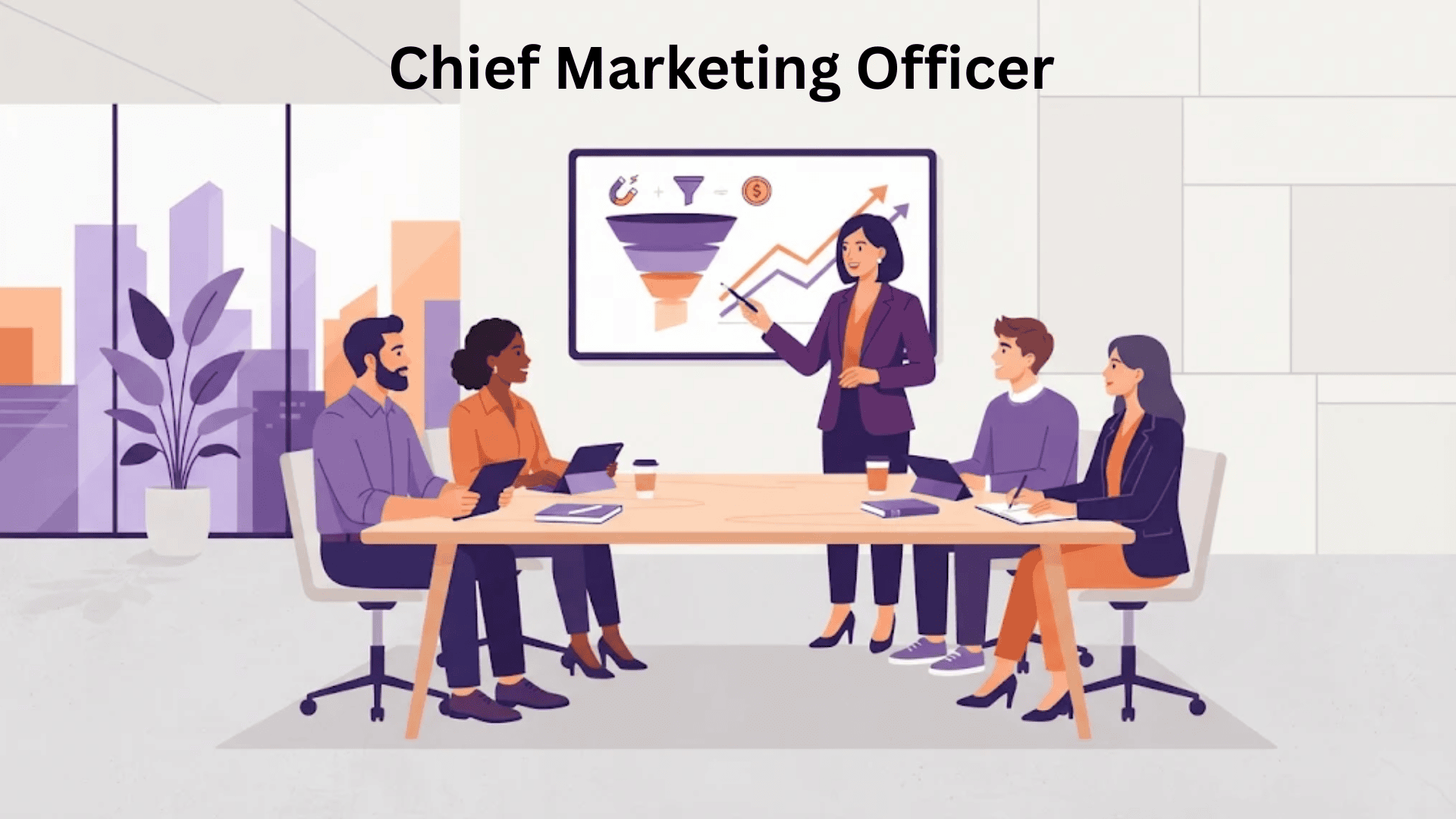
A chief marketing officer (CMO) is the senior executive responsible for a company’s marketing strategy: how it positions its brand, finds and keeps customers, and shows that marketing spending contributes to growth. The CMO usually sits on the executive team, works closely with the CEO, sales and finance leaders, and manages the marketing function and its budget.
The title sounds uniform, but the job is not. One venture investment firm’s hiring guide calls the CMO role one of the least consistent jobs in the C-suite, because what a CMO does at a 500-person company can look nothing like what one does at a 20-person startup. This guide explains what a CMO does, how the role differs from a VP of Marketing or a fractional CMO, the skills involved, the typical career path, and how to decide whether your company needs one.
Table of Contents
- What Is a Chief Marketing Officer?
- CMO at a Glance
- What Does a CMO Do?
- Consumer vs Enterprise CMOs
- CMO vs VP of Marketing vs Other Marketing Leaders
- The Changing CMO Title
- Skills and Qualifications
- The Typical Career Path to CMO
- Does Your Company Need a CMO?
- Signs You May Be Ready
- Signs You May Not Be
- Alternatives to a Full-Time CMO
- How Much Does a CMO Earn?
- How to Hire a CMO: A Practical Approach
- A Hypothetical Example
- Frequently Asked Questions
- What does CMO stand for?
- What does a chief marketing officer do?
- What is the difference between a CMO and a VP of Marketing?
- Does a small business need a CMO?
- What is a fractional CMO?
- What qualifications do you need to become a CMO?
- Who does the CMO report to?
- Conclusion
What Is a Chief Marketing Officer?
A chief marketing officer is the top marketing leader of an organization. The University of Maryland’s online business program describes the role as an executive position responsible for creating, strategizing, planning, and executing a company’s marketing efforts. In most companies, the CMO reports to the CEO and leads a team that may include brand, content, digital, product marketing, communications,s and analytics specialists.
CMO at a Glance
| Item | Summary |
|---|---|
| Full title | Chief marketing officer |
| Level | C-suite executive, usually reporting to the CEO |
| Core purpose | Drive demand and brand growth, and be accountable for marketing results |
| Works closely with | CEO, sales or revenue leaders, CFO, product, customer success, SS, and technology teams |
| Varies by | Company size, industry, business model (consumer vs enterprise) and growth stage |
What Does a CMO Do?
One industry article summarizes the modern CMO’s job as four roles: growth driver, innovation catalyst, capability builder, and brand storyteller. In practice, that translates into these responsibilities.
- Setting marketing strategy. Deciding which customers to target, how to position the product, what to say, and which channels to use.
- Owning the brand. Keeping the company’s message, identity,y and reputation consistent across channels.
- Driving demand and growth. Overseeing campaigns and programs that generate leads and customers. In many B2B software companies, the CMO owns pipeline and revenue contribution in partnership with the head of sales, according to Toptal’s guidance for SaaS firms.
- Understanding customers and markets. Using research, data, TA, and competitor analysis to guide decisions. A regular SWOT analysis is one simple tool for this.
- Managing the budget. Allocating spending across channels and showing the return, usually in conversation with the CFO.
- Leading the team. Hiring, developing, ing and organizing marketers, agencies, and technology.
- Working with sales and product. Aligning messaging, launches and customer feedback with the people who sell and build the product.
- Measuring performance. Reporting results to the CEO and board, such as pipeline, revenue contribution, customer acquisition cost, retention,n and brand awareness.
Consumer vs Enterprise CMOs
The venture firm Andreessen Horowitz noted in a 2017 hiring article that the role differs between consumer and enterprise businesses. In consumer companies, the CMO is often responsible for direct user acquisition through advertising and organic channels. In enterprise or B2B companies, the work leans more toward positioning, product marketing, demand generation, and supporting sales. That article is several years old, but the broader point still holds: define which kind of CMO you need before you hire.
CMO vs VP of Marketing vs Other Marketing Leaders
| Role | Typical scope | Often found in |
|---|---|---|
| Chief marketing officer (CMO) | Overall marketing strategy, brand, growth, wth and accountability for results at the executive level | Larger or scaling companies |
| VP of Marketing | Runs marketing day-to-day, manages the team, and executes the plan | Startups and mid-size companies |
| Head of Growth | Narrower focus on acquisition and product-led growth | Companies with proven product-market fit |
| Fractional CMO | Part-time senior marketing leadership, usually strategy and oversight | Early-stage or small companies without a full-time leader |
| Marketing consultant or agency | Defined projects or services, not ongoing leadership | Any stage |
The University of Maryland program notes that the CMO tends to carry more of the analysis and metrics work, such as ROI analysis, than a marketing vice president does. Investors writing about startup hiring also describe the VP of Marketing as an undervalued option for seed and early-stage companies that can grow into a CMO role later, though that is one firm’s view.
The Changing CMO Title
Not every large company has a traditional CMO. An Inc. article reported that roughly one-third of Fortune 500 companies lacked an enterprise-wide marketing leader, while others had created broader “CMO+” roles combining marketing with customer, commercial, growth, or strategy responsibilities. The lesson for smaller companies is that the title matters less than the scope of authority and accountability.
Skills and Qualifications
There is no single required path, but employers usually look for a mix of the following.
- Strategic thinking. Setting direction and prioritizing, not just running campaigns. One industry article says that understanding strategy versus tactics makes the difference in prioritizing marketing needs.
- Brand and positioning expertise.
- Data and analytics. Measuring results, testing, and tying marketing to revenue.
- Digital and technology fluency. Understanding channels, customer data, and marketing technology.
- Leadership and communication. Building teams, working with the CEO and board, and aligning with sales and finance.
- Financial literacy. Budgeting, forecasting,g and explaining return on spend.
- Education. A bachelor’s degree in business administration or a related field is often cited as a minimum, and some CMOs hold an MBA. Experience and results often matter more than any specific degree.
The Typical Career Path to CMO
Many CMOs progress through marketing roles of increasing scope, for example from marketing manager to director to VP, and some come from adjacent areas such as sales, product, consulting, or growth. Other paths include founders who built marketing functions themselves. Executive search firms and professional associations track the details if you want current data on tenure and backgrounds.
Does Your Company Need a CMO?
There is no revenue figure or funding round at which every company suddenly needs one. One advisory article puts the better question this way: have your marketing problems become strategic rather than purely operational? MarTech’s guidance argues that most startups do not need a CMO and often cannot afford one. For companies under about $10 million in revenue, it suggests fractional leadership may be more practical.
Signs You May Be Ready
- Marketing involves several channels, a team,m and a meaningful budget, and nobody senior is setting direction across them.
- Messaging and brand are inconsistent between sales, product, and marketing.
- Growth has stalled, and the cause is unclear.
- You are entering new markets or launching new products, and need a coordinated plan.
- The CEO or founder is spending too much time on marketing decisions that others could own.
- Investors or the board are asking for clearer marketing metrics.
Signs You May Not Be
- You have not yet found a repeatable way to acquire customers, so you need testing and execution more than executive oversight.
- Your problem is a lack of execution, such as content or ads, which a specialist or agency can handle.
- Budget would force you to hire a CMO with no team or resources.
- You are unclear about what you would ask the CMO to achieve in the first year.
Alternatives to a Full-Time CMO
- Fractional CMO. A part-time executive who may work with several companies. One source reports that a fractional CMO needs someone in-house, or the budget to hire one, to delegate execution to.
- VP of Marketing or Head of Marketing. A hands-on leader who runs the function.
- Marketing consultant or agency. Useful for defined projects.
- Founder-led marketing with outside help, at the earliest stages.
Fractional CMOs are promoted by vendors who sell them, so be careful with published price ranges and success claims. Ask for scopes, references, and measurable goals, and compare quotes.
How Much Does a CMO Earn?
Pay varies widely by company size, industry, location,n and structure, and often includes bonus and equity. We have not included a salary figure here because published figures differ and change. For current numbers, check a recent compensation survey from a reputable executive search firm or salary-data provider, and compare roles of similar scope.
How to Hire a CMO: A Practical Approach
- Define the problem. Is it brand, demand generation, product marketing, or team building?
- Define scope and authority. Which functions report to the CMO, what budget do they control, and how do they work with sales?
- Set measurable first-year goals. For example, pipeline contribution, customer acquisition cost, cost, or retention, depending on your model.
- Match the profile to the stage. A hands-on builder suits an early company, and a leader of leaders suits a larger one.
- Interview with real scenarios. Ask candidates to explain how they would diagnose your marketing, what they would do in 90 days, and how they would measure it.
- Check references. Speak to former CEOs, sales leaders,s and team members.
- Plan the first 90 days. Agree on priorities, reporting and decision rights from the start.
One commentator describes founders hiring CMOs expecting a miracle and then facing fuzzy expectations, unclear timelines, and misaligned responsibilities. Clear scope and goals are the best protection against that.
A Hypothetical Example
This example is hypothetical and for illustration only.
A 60-person software company has grown quickly through referrals. The founder has been running marketing alongside an agency, a content manager,r and a paid-ads specialist. Sales says the leads are poor, product says the messaging does not match the product, and the board wants clearer numbers. The founder decides the problem is no longer execution but direction. Rather than hire a full-time CMO immediately, she brings in a fractional CMO for six months to audit the funnel, rewrite the positioning, ng and build a reporting dashboard. At the end of that period, the company decides whether to promote the content manager to head of marketing, hire a VP of Marketing, ing or recruit a full-time CMO. The decision rests on what the audit finds, not on a title.
Frequently Asked Questions
What does CMO stand for?
Chief marketing officer.
What does a chief marketing officer do?
A CMO sets marketing strategy, leads the marketing team, owns the brand, drives demand and growth, manages the budget, and reports results to the CEO and board.
What is the difference between a CMO and a VP of Marketing?
A CMO is an executive-level leader accountable for overall marketing strategy and results. A VP of Marketing typically runs the function day-to-day and manages execution. The split varies by company.
Does a small business need a CMO?
Usually not a full-time one. Many small businesses use a marketing manager, an agency, or a fractional leader until their marketing becomes complex enough to need executive direction.
What is a fractional CMO?
A part-time marketing executive who provides senior leadership without the cost of a full-time hire. They often work with several companies at once and typically need a team or budget for execution.
What qualifications do you need to become a CMO?
There is no single requirement. Many CMOs have a bachelor’s degree in business or a related field, and some have an MBA, but employers weigh experience, leadership,p and results most.
Who does the CMO report to?
Most often the CEO, although some CMOs report to a chief revenue officer, chief commercial officer, er or other executive, depending on the company.
Conclusion
A chief marketing officer is a company’s senior marketing leader, responsible for strategy, brand, growth, wth and results. The role is not standardized, so the title matters less than the scope, authority, and goals that come with it. Many companies, especially early-stage ones, get more value from a VP of Marketingfractionalna,l ,CMO or a strong specialist team until their marketing challenges become truly strategic.
Next step: write down your three biggest marketing problems and label each as strategic or operational. If most are strategic, define the scope and measurable goals for a senior marketing leader, then decide whether a full-time, fractional, or interim model fits your stage.
This article is for general educational purposes only and is not hiring, legal or financial advice. Executive roles, titles and compensation vary widely by company and country, so verify details with qualified advisers before making hiring decisions.